On the day a seed round closes, a startup acquires an organ it did not have the week before. The investors get a seat, the founders keep theirs, and a group of three people begins to hold the legal power over a company they have been running by instinct. Nothing about the office changes. The Delaware statute that governs most venture-backed companies gives that group the whole job in one sentence: the business and affairs of the corporation are managed by or under the direction of a board of directors1.
This page follows a board through its life: the powers the law gives it, the work it does, the duties its members owe, who sits on it at seed, at Series A and at the edge of an IPO, and what the seats are paid. It sits in the board hub, next to board reporting, which covers the financial package a board reads before each meeting.
What the law gives the board
The statute is short on detail and long on discretion. A board consists of 1 or more members, each a natural person1. The number of directors is fixed by the bylaws, unless the certificate of incorporation fixes it1. Directors need not be stockholders unless the certificate or bylaws require it1. A single founder can therefore be a board of one, and a company can add seats by amending its bylaws or its charter.
Three more powers shape how a startup board works day to day.
- Committees. The board may designate 1 or more committees, each made up of 1 or more directors1.
- Written consent. Unless the charter or bylaws restrict it, any action that can be taken at a meeting can be taken without one if all members consent in writing or by electronic transmission1.
- Pay. Unless restricted, the board has the authority to fix the compensation of directors1.
What a startup board does
The practitioner sources agree on the core list. Boards oversee major matters such as executive leadership, fundraising, capital allocation, governance and shareholder interests2. Board members are responsible for hiring and, if necessary, replacing the CEO and senior executives4. Executive hiring and compensation are determined by the board2. Board members also review and approve major financial decisions and ensure accurate reporting and compliance with financial regulations4.
ImBoard compresses this into three primary responsibilities: fiduciary oversight, strategic guidance, and CEO support and evaluation3. Its fiduciary examples are approving budgets and major expenditures and ensuring legal compliance3. The budget approval is the step this site covers in startup annual budget.
Matt Munson, who writes about startup boards, points at an uncomfortable fact: the board does hold the accountability of hiring, and at times firing, the CEO10. His argument is that framing the whole relationship around that one power makes a poor working setup, and that a board’s primary job can be helping the CEO flourish in the role10. That is one practitioner’s view, not a legal standard, and it explains why many founders choose directors for judgment first.
The basic responsibilities of a startup board member
A list of responsibilities for individual directors, assembled from the sources, looks like this. Each item has a source; the order is the editors’.
| Responsibility | In practice | Source |
|---|---|---|
| Hire, evaluate and, if needed, replace the CEO | Set performance benchmarks, review regularly, give feedback, and decide on leadership changes | 3, 4 |
| Approve executive compensation | The board determines executive hiring and compensation | 2 |
| Approve budgets and major expenditures | Fiduciary duties include approving budgets and major expenditures | 3 |
| Decide on fundraising and capital allocation | Boards oversee fundraising and capital allocation | 2 |
| Ensure accurate reporting | Review and approve major financial decisions and make sure reporting is accurate | 4 |
| Identify and mitigate risk | Identify potential risks, assess their impact, implement mitigation | 3 |
| Ensure legal compliance | Part of the fiduciary duties | 3 |
| Provide strategic guidance | One of three primary responsibilities | 3 |
| Meet the duties of care, loyalty and confidentiality | The formal responsibilities in a university startup guide | 5 |
| Prepare for and keep a record of meetings | Pre-meeting materials so discussion is informed; record meetings carefully, however casual | 3, 2 |
The list is the editors’ synthesis of these sources, and its length is a convenience, not a standard.
Munson adds a warning that explains many weak boards. He is amazed how often CEOs have no idea what the actual job of a board member is, and some recruit people to their boards without giving any clear expectations10. The table above is one answer: write the responsibilities down, and hand them to the director with the term sheet.
The duties directors owe
Responsibilities describe what a board does. Fiduciary duties describe what each director owes the corporation and its stockholders, and they are where legal risk sits. A university startup guide names the duties of care, loyalty and confidentiality among a board’s formal responsibilities5. Delaware’s statutes lean on loyalty and good faith. The clause that lets a charter limit directors’ personal liability for monetary damages carves out four things it cannot reach7:
- any breach of the duty of loyalty7;
- acts or omissions not in good faith, or involving intentional misconduct or a knowing violation of law7;
- a director’s liability under section 174 of the title7;
- any transaction from which the director derived an improper personal benefit7.
So a startup charter can protect a director from some claims of carelessness, and cannot protect one from a claim that the director acted disloyally or in bad faith. That is the reason loyalty gets the attention.
Oversight: the duty to have a reporting system
The most useful modern statement of the oversight duty comes from the Delaware Supreme Court’s December 18, 2023 opinion in a case about a drug distributor that faced the loss of its drug distribution licenses6. The court restated the Caremark standard: boards must assure themselves that information and reporting systems exist in the organization that are reasonably designed to provide senior management and the board itself with timely, accurate information sufficient to reach informed judgments about both compliance with law and business performance6. In deciding whether those systems are adequate, directors must exercise good-faith judgment, and failing to do so breaches the duty of loyalty6.
Liability for oversight has two prongs. Either the directors utterly failed to implement any reporting or information system or controls, or having implemented one, they consciously failed to monitor or oversee its operations, disabling themselves from being informed of risks or problems requiring their attention6. Where directors fail to act in the face of a known duty to act, with conscious disregard for their responsibilities, they breach the duty of loyalty by failing to discharge the obligation in good faith6.
For a startup the practical reading is modest and concrete. The financial package is the board’s information and reporting system, which is why board reporting matters beyond good manners. This page explains the legal framework; it is not legal advice, and a lawyer applies it to a particular company.
Reliance on management’s reports
The statute pairs the duty with a protection. A director is fully protected in relying in good faith on the corporation’s records and on information, opinions, reports or statements presented by its officers or employees1. The protection has limits: for outside experts it applies to matters the director reasonably believes are within the expert’s competence, and the person must have been selected with reasonable care1. A board that never asks a follow-up question about a report is relying on it, but not necessarily in good faith.
When a director has a stake in the deal
A startup board approves transactions with its own members constantly: a director’s fund leads the next round, or a founder’s company sells services to the startup. The statute sets a safe path. The act or transaction is protected when its material facts are disclosed or known to the board or committee, and the board or committee in good faith, without gross negligence, authorizes it by the affirmative votes of a majority of the disinterested directors1. The detail that matters in practice is who counts as disinterested: the interested director’s vote does not help.
How many board members should a startup have?
The statute sets a floor of one1, so size is a design choice, and practitioners converge on three to five. Rho reports that startups typically start with three to five board members, including founders, investors and independent directors4. ImBoard gives the same range3. Mercury puts the early-stage board at often three members, which supports efficient decisions and reduces the risk of tied votes2. A typical board has an odd number of members to prevent deadlocks2.
At Series A the same source gives two options: three or five people2. If the board stays at three, a founder who gives up a seat for the new investor can become an observer, who cannot vote but still has direct access to the decision-making2.
| Stage | Typical size in the sources | Who fills the seats | Source |
|---|---|---|---|
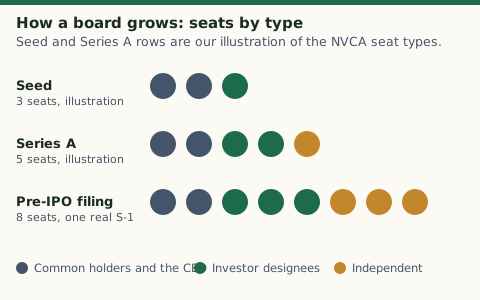
| Seed | Three | Founder and CEO, a high-level employee such as a co-founder, a non-employee investor | 2 |
| Seed, another view | Founder-heavy, perhaps one investor representative | Founders plus an investor | 4 |
| Series A | Three or five | Common, preferred and independent seats | 2 |
| Before an IPO, one filing | Eight | See the case below | 9 |
Who the seats belong to
Seats come from the company’s charter and its voting agreement, and the NVCA’s model voting agreement shows the standard vocabulary. It lists a preferred director, designated by a named investor8. It lists a common director, designated by the key holders who hold a majority of the common stock held by key holders8. It names the CEO as the CEO director, and if the CEO changes, the stockholders vote to remove the former CEO from the board if that person has not resigned8. And it lists a mutual director, an individual who is not otherwise an affiliate of the company or of any investor and is designated by mutual agreement of the other seated members8. The statute makes this possible: the certificate of incorporation can give holders of any class or series of stock the right to elect 1 or more directors1.
Munson observes that for most startups the people on the board are 1-2 founders because they founded it and 1-2 investors because they wrote a check, and calls that a default, not a design10. The mutual director is the model agreement’s way of making it a design.
A real board, seed to IPO
Figma’s 2025 registration statement is a rare public view of how a venture board ends up. The company’s board consisted of eight directors9. Two were elected by holders of the Class B common stock as designees of certain common holders9. Three were investor designees: one elected by holders of the Series Seed preferred stock, one by holders of Series A preferred, and one by holders of Series B preferred9. The remaining three were elected as independent directors, nominated by the unanimous approval of each other member of the board9. One director, its only employee director, sat on the board as an insider9.
The filing then shows the board changing shape for the IPO. The voting agreement terminates, and the charter provisions by which directors were elected are amended and restated in connection with the offering9. After the offering, the number of directors is fixed by the board itself9. Independence becomes a listing requirement: under the exchange’s rules independent directors must comprise a majority of a listed company’s board within a specified period after the offering9. Audit committee members must also satisfy the independence criteria in Rule 10A-39. And the board adopts governance guidelines providing that one independent director serves as lead independent director9.
- Seed. A small board: founder-heavy, perhaps one investor representative4.
- Each priced round. A new preferred series elects its own designee, as the Series Seed, A and B seats show9.
- Independents. Directors with no material relationship with the company join, and the existing board nominates them4, 9.
- The offering. The voting agreement ends, independence becomes a listing rule, committees are formed9.
Committees, once the company is public-bound
The filing’s board has an audit committee, a compensation committee, and a nominating and corporate governance committee9. The audit committee’s functions include selecting the independent accounting firm, reviewing interim and year-end operating results with management and that firm, and considering the adequacy of internal controls and the internal audit function9. The compensation committee reviews and approves executive officer compensation and administers the stock and equity incentive plans9. The nominating and governance committee identifies and recommends candidates for board membership9.
The company has no standing risk management committee9. The audit committee is responsible for overseeing major financial risk exposures and the steps management has taken to monitor and control them9. A startup does not need this structure on day one, but the statute makes committees optional and available at any stage1, and the audit and compensation functions are the ones most likely to be needed first.
Independent directors
An independent director, also called a non-executive director, is a member of the board who has no material relationship with the organization4. ImBoard gives the case for adding one: independent directors provide unbiased oversight, help mitigate conflicts of interest and bring fresh perspectives3. Mercury recommends that the CEO not also chair the board, because a separate chairperson helps maintain a separation of board and CEO interests2.
What directors are paid
At the early stage, mostly nothing in cash. Founders and investor representatives generally are not separately paid for board service, while independent directors may receive equity and, at later stages, cash compensation2. Rho reports equity of 0.5% to 2% as common for board members4, a vendor figure without a stated sample, so treat it as a range of practice and not a norm.
The Figma filing shows the later-stage version. In the year covered, the company did not pay any fees or other compensation to its non-employee directors, other than certain equity awards9. After the offering, the director pay plan sets a general board service fee of $40,000, with additional fees for chairs of committees, such as $25,000 for the audit committee chair9. The statute puts the decision in the board’s own hands, subject to the charter and bylaws1.
How a board makes a decision: quorum and votes
The mechanics matter more than founders expect. A majority of the total number of directors is a quorum, unless the charter or bylaws require more1. The vote of the majority of the directors present at a meeting with a quorum is the act of the board, unless the charter or bylaws require a greater number1. Combined, those two rules mean a motion can carry with fewer yes votes than a simple majority of all seats.
Worked example (our arithmetic): the fewest yes votes that can carry a motion at three Fernwood boards (quorum and voting rules from1; Fernwood is a made-up company, and its bylaws are assumed to add nothing)
| Seats | Quorum (majority of seats) | Directors at the meeting | Yes votes that carry (majority of those present) |
|---|---|---|---|
| 3 (seed) | 2 | 2 | 2 |
| 5 (Series A) | 3 | 3 | 2 |
| 8 (pre-IPO size) | 5 | 5 | 3 |
At five seats, three directors make a quorum and two of them can act: 2 of 5 seats, or 40%. At eight seats the figure is 3 of 8, or 37.5% (our arithmetic). This is why a board that matters to investors fixes higher thresholds in its charter, bylaws or voting agreement, and why directors attend. Written consent works the other way: action without a meeting needs all members to agree1.
Removal is the other mechanic. Any director, or the entire board, may be removed with or without cause by the holders of a majority of the shares entitled to vote at an election of directors, and only for cause where the board is classified, unless the charter provides otherwise1. The model voting agreement adds the investor side: a director is promptly removed on the written request of those entitled to designate a replacement8.
Run the meeting like the record will be read
Meetings are where all of this turns into evidence. Mercury recommends recording board meetings fastidiously, however early or casual they are2. ImBoard points to the supporting practice: meetings scheduled regularly, with a clear agenda and comprehensive pre-meeting materials, so discussion is informed3. The materials are the subject of board reporting, and the budget the board approves is in startup annual budget.
Common questions
What is the 80/20 rule for startups?
The Pareto principle states that in many cases roughly 80% of the effects come from 20% of the causes11. For a board it is a way to spend scarce meeting time: find the few customers, cost lines and risks that drive most of the result. It is a rule of thumb and not a law11.
What are the three main duties of a board of directors?
One practitioner summary names three responsibilities: fiduciary oversight, strategic guidance, and CEO support and evaluation3. The legal duties are a different list. A university startup guide names the duties of care, loyalty and confidentiality5. Delaware case law treats failure to act in good faith as a breach of loyalty6.
If this left you with a question, start with Startup board financial package: what to include or Startup stock options: ISO vs NSO tax, 409A, Rule 701.
Sources
- 8 Del. C. 141 and 144, Board of directors; interested directors (Delaware Code Online, Title 8, Chapter 1, Subchapter IV) · State of Delaware · delcode.delaware.gov · checked October 21, 2026
- How to create a board of directors for your early-stage startup · Mercury · mercury.com · checked October 21, 2026
- Understanding the Roles of a Startup Board of Directors · ImBoard · imboard.ai · checked October 21, 2026
- Build an Effective Startup Board · Rho · rho.co · checked October 21, 2026
- Week 2: Startup Governance (Startup Education Series) · Tech Launch Arizona, University of Arizona · techlaunch.arizona.edu · checked October 21, 2026
- Lebanon County Employees' Retirement Fund v. Collis, Delaware Supreme Court, decided December 18, 2023 · Supreme Court of the State of Delaware · courts.delaware.gov · checked October 21, 2026
- 8 Del. C. 102, Contents of certificate of incorporation (Delaware Code Online, Title 8, Chapter 1, Subchapter I) · State of Delaware · delcode.delaware.gov · checked October 21, 2026
- NVCA Model Voting Agreement (updated June 2026) · National Venture Capital Association · nvca.org · checked October 21, 2026
- Figma, Inc. Form S-1 registration statement (2025) · Figma, Inc. (SEC filing) · sec.gov · checked October 21, 2026
- How to Build a Startup Board of Directors: Board Member Roles, Responsibilities & Trust · Matt Munson · mattmunson.me · checked October 21, 2026
- Applying the Pareto Principle in Your Marketing, the 80/20 Rule (updated June 4, 2021) · University of Maryland Extension · extension.umd.edu · checked October 21, 2026
Published . Rules and rates change: each source shows the day it was read. Education only, not advice. How we check facts · Report an error.