On this page
- Terms you will meet
- ISO vs NSO: key differences
- Telling an ISO from an NSO
- Tax treatment at grant, exercise and sale
- The $100,000 limit on ISO treatment
- ISO requirements, one by one
- The 409A valuation behind your strike price
- Exercising ISOs: holding period, AMT and disqualifying dispositions
- Nonstatutory options: when income arises
- Early exercise, restricted stock and the 83(b) election
- Qualified equity grants: section 83(i)
- Reporting forms
- ISOs or RSUs: neither wins in general
- Rule 701: how many options a private company can grant
Part of the equity and finance team section. This page covers the United States federal income tax treatment as set out in IRS Topic 427, Publication 525 (2025 edition) and section 422 of the Internal Revenue Code, 2024 edition. State tax, non-U.S. rules, the AMT credit and qualified small business stock are outside its scope, and your own facts will differ, so use it to understand the rules before talking to a tax adviser.
Terms you will meet
Five terms carry most of this page. Each is defined here once and used the same way below.
- Strike price. The agreed price per share you pay to exercise6.
- Readily determinable value. An option has one when it is actively traded on an established market, or when it is untraded but you can transfer it and exercise it immediately in full, among other conditions1, 2.
- Substantial risk of forfeiture. Your rights to the property depend on you performing substantial services in the future, so unvested stock can still be taken back4.
- Disqualifying disposition. Selling ISO stock before the holding periods are met, which turns part of the gain into ordinary income1, 2.
- Alternative minimum tax (AMT). A parallel tax calculation in which the gain on ISO stock at exercise counts as an adjustment even though regular tax ignores it2.
Before reading further, pull out your grant paperwork and check four things. The label comes first: does the grant call the option an incentive stock option or a nonstatutory one? It decides which column of every table below applies1. Then the strike price, which you should compare with the fair market value on the grant date, and ask how the company set that value (the 409A section below)10. Third, the vesting terms, which can be time served or performance milestones and decide when stock stops being forfeitable6. Last, the exit rules: for an ISO you must be an employee from grant until 3 months before exercise (1 year if disabled), so ask what happens to your options when you leave3.
ISO vs NSO: key differences
Startups hand out options as part of pay6. What follows depends on one thing: the tax category the option was granted under. A statutory option generally carries no income at grant or exercise. A nonstatutory option turns on whether it has a readily determinable fair market value, and most do not, so the stock’s value at exercise, less what you paid, becomes income when you exercise1.
| Question | Statutory option (includes ISO) | Nonstatutory option (NSO) |
|---|---|---|
| What is it? | An option granted under an employee stock purchase plan or an ISO plan1 | An option granted under neither1 |
| Income at grant? | Generally none2 | Possible, only if the option has a readily determinable value2 |
| Income at exercise? | Generally none for regular tax1 | Yes, when there is no readily determinable value: the value of the stock received less the amount paid1 |
| Tax at sale? | Taxable income or deductible loss on the stock sold1 | Taxable income or deductible loss on the stock sold1 |
| Alternative minimum tax? | Possible in the year an ISO is exercised1 | No ISO-style adjustment; that AMT adjustment applies only to stock acquired through an ISO2 |
| Employer form | Form 3921 after an ISO exercise1 | Amount reported on Form W-2, box 12, code V2 |
Telling an ISO from an NSO
Ask your employer which kind you hold2. The grant paperwork settles it, because the type is fixed by how the option was granted: options under an employee stock purchase plan or an ISO plan are statutory, and anything granted under neither is nonstatutory1.
An option can also lose its ISO status. If you do not meet the employment requirements, or you receive a transferable option, the option is a nonstatutory stock option2. And an option over the annual dollar limit, covered below, is treated as not being an ISO to that extent3.
After an ISO exercise, the corporation files a Form 3921 and furnishes a statement to the person named on it5. After an exercise of a nonstatutory option, the amount appears on the W-2 with code V2.
Tax treatment at grant, exercise and sale
Grant
A statutory option creates no income when you receive it. A nonstatutory option can, but only if its value is readily determinable. Most are not, so there is nothing to report until you exercise or transfer the option2.
That is a high bar. An option actively traded on an established market clears it1. An untraded option clears it only if every condition on a list holds, including that you can transfer it and exercise it immediately in full2.
Exercise
| Option type | Regular income tax at exercise |
|---|---|
| Statutory (ISO) | No amount included in income2 |
| NSO with a readily determinable value at grant | No amount included at exercise2 |
| NSO without a readily determinable value, stock vested | Difference between the amount paid and the stock’s FMV when it becomes substantially vested2 |
| NSO without a readily determinable value, stock unvested | Nothing at exercise; included when the stock becomes substantially vested2 |
The basis in stock acquired under a nonstatutory option is the amount paid plus any amount included in income at grant or exercise2.
Sale
Sell the shares and you have a taxable gain or a deductible loss, generally capital1. The ISO exception is the one to remember: sell before the holding periods are met and the income is ordinary instead1.
The $100,000 limit on ISO treatment
The Code caps ISO treatment at $100,000 of stock a year. Add up the fair market value of the stock under every ISO that first becomes exercisable for one person in a calendar year, across all plans of the employer and its parent and subsidiaries. Anything over $100,000 is treated as a nonstatutory option3.
That is the 2024 edition of the Code, the latest on govinfo.gov when we checked on October 21, 20263. Three details complete the rule:
- The limit counts options by when they first become exercisable, not when they were granted3.
- Options are taken into account in the order in which they were granted3.
- The fair market value of the stock is determined as of the time the option is granted3.
An option over the limit does not disappear. To that extent it is treated as an option which is not an incentive stock option, which puts it among the options granted under neither plan type3, 1.
ISO requirements, one by one
An option is an ISO only if it meets every item in the statute3.
| Requirement | Rule |
|---|---|
| Plan | Granted under a plan stating the total shares and the eligible employees, approved by stockholders within 12 months before or after adoption3 |
| Grant window | Granted within 10 years from the date the plan is adopted or approved, whichever is earlier3 |
| Term | Not exercisable after 10 years from the date of grant3 |
| Price | Option price not less than the fair market value of the stock at grant3 |
| Transfer | Not transferable except by will or the laws of descent and distribution, and exercisable only by the employee in life3 |
| Ownership | Employee does not own more than 10 percent of the voting power at grant3 |
| Employment | Employee for the whole period from grant until 3 months before exercise3 |
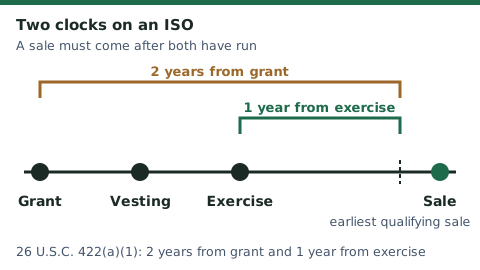
| Holding | No sale within 2 years of grant or within 1 year of exercise3 |
Two special rules adjust the table. For a 10-percent shareholder, the ownership limit is lifted if the option price is at least 110 percent of fair market value and the option is not exercisable after 5 years from grant3. For a disabled employee, the 3-month employment period becomes 1 year3.
The Code also forgives a good-faith valuation mistake. If there was a failure in an attempt, made in good faith, to meet the price requirement, the requirement is considered to have been met3. And an option does not stop being an ISO because the employee may pay for the stock with stock of the corporation granting the option3.
An option is also not an ISO if an election is made under section 83(i) with respect to the stock received on its exercise3.
The 409A valuation behind your strike price
A private company has no market price, so someone has to decide what a share is worth on the grant date. That number matters because of section 409A of the Internal Revenue Code, which governs deferred compensation10. An option whose exercise price is or could become less than the fair market value of the stock on the date of grant generally counts as deferred compensation under the Treasury regulation8. Incentive stock options and employee stock purchase plan options are carved out of that rule, and an ISO’s price requirement sits in its own statute8, 3.
For a nonstatutory option, the safe route is simple to state. The exercise price may never be less than the fair market value of the underlying stock on the date the option is granted, and the number of shares is fixed at grant8. A “409A valuation” is the work a private company does to show that its fair market value was set reasonably10.
How a company proves the value was reasonable
The regulation does not leave “reasonable” open. It presumes certain methods are reasonable, and the tax authority can rebut a presumption only by showing the method or its application was grossly unreasonable8.
| Route | What the regulation requires |
|---|---|
| Independent appraisal | A valuation of a class of stock by an independent appraisal, as of a date no more than 12 months before the transaction it is applied to, such as the option grant8 |
| Start-up written report | A valuation made reasonably and in good faith and evidenced by a written report, for illiquid stock of a start-up corporation8 |
The start-up route has conditions of its own, and a written report alone does not meet them.
- Company profile. No material trade or business conducted for 10 years or more, and no class of equity securities traded on an established securities market8.
- No buy-back rights. The stock cannot be subject to a put, call or other right or obligation of the company or another person to purchase it8.
- A qualified valuator. The company must reasonably determine that the person doing the work is qualified, and significant experience generally means at least five years in business valuation or appraisal, financial accounting, investment banking, private equity, secured lending or comparable work8.
- No imminent event. The route is unavailable when a change in control is reasonably anticipated within 90 days of the action the valuation supports, or a public offering within 180 days8.
The independent appraisal route has its own technical test: the appraisal must meet the requirements of section 401(a)(28)(C) and its regulations8.
When a valuation goes stale
A 409A value is not good for a fixed year no matter what happens. A previously calculated value stops being reasonable if it fails to reflect information that came out afterward and may materially affect the value of the corporation, such as the resolution of material litigation or the issuance of a patent8. It also stops being reasonable if it was calculated for a date more than 12 months before the date it is used8. A new priced funding round is the kind of event a finance team treats as fresh information about value, because investors have just put a price on the company. A valuation method is also unreasonable if it ignores available information that is material to the value of the corporation8.
What happens when the strike price is too low
A failure under section 409A is costly and it lands on the employee. All compensation deferred under the plan for the year and earlier years becomes includible in gross income to the extent it is not subject to a substantial risk of forfeiture10. On top of the regular tax, the statute adds an amount equal to 20 percent of the compensation required to be included, plus interest at the underpayment rate plus 1 percentage point10. That is why founders set the strike price off a written valuation, not off a round number.
The ISO rules handle a missed price differently. A good-faith attempt to meet the ISO price requirement counts as meeting it3. For a nonstatutory grant, the price rule above is the one that protects the employee.
Exercising ISOs: holding period, AMT and disqualifying dispositions
The holding period
The holding period requirement is satisfied when the stock is not sold until the end of the later of the 1-year period after the stock was transferred and the 2-year period after the option was granted2. The holding period for the property acquired on exercise begins on the day after the exercise2.
| Outcome | Tax result |
|---|---|
| Holding period met | The gain or loss from the sale is capital gain or loss2 |
| Holding period not met, gain | The gain is ordinary income up to the amount by which the stock’s FMV at exercise exceeded the option price2 |
| Holding period not met, loss | A capital loss, with no ordinary income2 |
The ordinary income is reported by the employer as wages in box 1 of Form W-22. The Code also limits the compensation amount when a disqualifying sale is made at a loss: it shall not exceed the excess of the amount realized over the adjusted basis3.
The IRS gives a case. An employer granted an ISO on March 12, 2023, to buy 100 shares at $10 a share, its FMV at the time2. The option was exercised on January 7, 2024, when the stock sold for $12 a share, and the stock was sold on January 27, 2025, for $15 a share2. Although the stock was held for more than a year, less than 2 years had passed from the time of grant2. In 2025, the difference between the option price ($10) and the value of the stock when exercised ($12) must be reported as wages2.
Alternative minimum tax
For the AMT, stock acquired through the exercise of an ISO is treated as if no special treatment applied2. When the rights in the stock are transferable or no longer subject to a substantial risk of forfeiture, the amount by which the FMV exceeds the option price is an adjustment in figuring alternative minimum taxable income2. No adjustment is required if the stock is disposed of in the same year as the exercise2. The AMT basis in the stock is likely to differ from the regular tax basis, so both need to be tracked2.
IRS example: an ISO granted on April 8, 2024, for 100 shares at $9 a share, its FMV at the time2. It was exercised on January 7, 2025, when the stock sold for $14 a share2. On January 27, 2025, with the stock at $16 a share, the rights to the stock first became transferable2. The IRS includes $700 ($1,600 value when the rights first became transferable, minus the $900 option price) as an adjustment on Form 6251, line 2i2.
Nonstatutory options: when income arises
For a nonstatutory option granted without a readily determinable value, there is no income until the option is exercised or transferred2. At exercise, the restricted property rules apply to the property received2. If the stock is not substantially vested at exercise, so that the holder may have to give it back, nothing is included until it becomes substantially vested2.
The employer reports the amount in box 12 of Form W-2 with code V2. Sale of the stock afterward has no special income rules: the sale is reported as a normal sale2.
Early exercise, restricted stock and the 83(b) election
Section 83 governs property transferred for services. The value of the property, less any amount paid, is included in gross income in the first taxable year in which the rights are transferable or not subject to a substantial risk of forfeiture4. Rights are subject to a substantial risk of forfeiture if full enjoyment of the property is conditioned on the future performance of substantial services4.
A person may elect to include the value in gross income in the year of transfer instead4. The election must be made not later than 30 days after the date of the transfer4. Section 83 does not apply to a transaction to which section 421 applies, the section the ISO statute invokes, nor to the transfer of an option without a readily ascertainable value3, 4.
Restricted stock and restricted stock units are different instruments with different tax consequences6. The shares underlying a restricted stock award are owned by the recipient on the date of grant6. The holder of an RSU does not own any shares on the date of the grant, because an RSU is a right to receive shares once vesting conditions are met6. Vesting conditions may include milestones such as length of employment or performance metrics6.
Qualified equity grants: section 83(i)
Section 83(i) lets a qualified employee of a private corporation defer income tax on qualified stock for up to 5 years from the date of vesting2. It applies to stock from options exercised or RSUs settled after 20172.
| Item | Rule |
|---|---|
| Plan | A written plan providing an RSU or option to at least 80% of U.S. employees2 |
| Qualified stock | Stock in the employer corporation4 |
| Election window | No later than 30 days after the rights become transferable or not subject to a substantial risk of forfeiture4 |
| Latest inclusion | 5 years after the first date the rights are transferable or not subject to a substantial risk of forfeiture4 |
| Withholding | At the highest marginal rate2 |
| Form | Form 15620 cannot be used to make a 83(i) election2 |
Reporting forms
| Form | Who files | What it carries |
|---|---|---|
| Form 3921 | Every corporation that transfers shares on an ISO exercise, for each transfer in the calendar year5 | Option grant date, exercise date, exercise price, FMV on exercise date and number of shares5 |
| Form 3922 | Corporation, for employee stock purchase plan transfers where the exercise price is below the grant-date value or not fixed5 | Dates, FMV and price paid5 |
| Form W-2, box 12 code V | Employer, after an NSO exercise2 | The spread on exercise2 |
| Form 6251 | Employee, for the AMT adjustment2 | The ISO adjustment on line 2i2 |
A Form 3921 is not required for an ISO exercise by a nonresident alien employee to whom no Form W-2 must be provided5. For 2025 exercises, the corporation had to furnish the statement by February 2, 202611. The usual January 31 date fell on a Saturday, and a due date on a Saturday, Sunday or legal holiday moves to the next business day11. Paper filing with the IRS was due March 2, 2026, and e-filing March 31, 202611. The e-file threshold is 10 returns, aggregated across all information returns5.
The next edition of the instructions is not out yet, so the date for this year’s exercises is our projection from the same weekend rule.
Our arithmetic: when the statement is due for exercises this year
| Step | Result |
|---|---|
| 2026 exercises: statement due date11 | January 31, 2027, which is a Sunday |
| Next business day11 | Monday, February 1, 2027 |
| Check11 | Confirm against the 2026 General Instructions when the IRS publishes them |
ISOs or RSUs: neither wins in general
Neither wins in general, because they trade different things. An ISO is a purchase right. You pay the strike price, regular tax waits until you sell if you meet the holding periods, and you carry an AMT adjustment in the exercise year1, 2. An RSU is a right to receive shares once vesting conditions are met, so you own nothing, and pay nothing, until then6. The ISO gives you control over when to exercise and the AMT risk that comes with it. The RSU gives you no exercise decision and a different tax profile6. If you are choosing between them, run your own numbers with a tax adviser before the grant, because the answer turns on your income, your company’s plan and what the stock is worth.
Rule 701: how many options a private company can grant
Options are one of several securities a startup issues, beside stock, membership interests, convertible notes and other forms6. Rule 701 is the exemption written for paying people with equity. It covers sales made to compensate employees, consultants and advisors in a non-capital raising transaction, and it is not available to Exchange Act reporting companies7, 9. The sale must be under a written compensatory benefit plan or written compensation contract, and consultants and advisors qualify only as natural persons9.
Rule 701 is not a way to raise money. It is not available for plans or schemes to raise capital7, 9. Funding rounds rely on other exemptions, such as Rule 506(b) of Regulation D12, which how venture rounds work walks through, under fundraising mechanics.
The ceiling
The amounts below are as they stand in the eCFR text checked October 21, 2026.
In any consecutive 12-month period, the aggregate sales price of securities sold under Rule 701 must not exceed the greatest of three amounts9, 7:
| Test | Limit |
|---|---|
| Fixed amount | $1,000,0009 |
| Assets | 15% of the issuer’s total assets at its most recent balance sheet date9 |
| Class | 15% of the outstanding amount of the class of securities being sold under the rule9 |
Two counting rules matter for option grants. For the ceiling, securities underlying options count on the date of the option grant, not the exercise date9. And options are valued on the exercise price, so a low strike price leaves more of the ceiling free9.
When the disclosure duty starts
If sales in any consecutive 12-month period exceed $10 million, the issuer must deliver the plan disclosure to investors a reasonable period before the sale, and for a stock option that disclosure goes out a reasonable period before exercise9. A growing company should therefore track the 12-month total grant by grant9. Rule 701 does not replace the 409A work above. Rule 701 settles whether the grant can be made without registration, and 409A settles what price the grant carries7, 8, 9, 10.
Related409A valuation: what it is, how it works, what it costs
Sources
- Topic no. 427, Stock options · Internal Revenue Service (page reviewed 24 September 2026) · irs.gov · checked October 21, 2026
- Publication 525 (2025), Taxable and Nontaxable Income: Stock Options · Internal Revenue Service · irs.gov · checked October 21, 2026
- 26 U.S.C. 422, Incentive stock options (2024 edition) · U.S. Government Publishing Office, United States Code · govinfo.gov · checked October 21, 2026
- 26 U.S.C. 83, Property transferred in connection with performance of services (2024 edition) · U.S. Government Publishing Office, United States Code · govinfo.gov · checked October 21, 2026
- Instructions for Forms 3921 and 3922 (Rev. April 2025) · Internal Revenue Service · irs.gov · checked October 21, 2026
- Common Startup Securities · U.S. Securities and Exchange Commission · sec.gov · checked October 21, 2026
- Exempt Offerings (Rule 701) · U.S. Securities and Exchange Commission · sec.gov · checked October 21, 2026
- 26 CFR 1.409A-1, Definitions and covered plans · Electronic Code of Federal Regulations (Treasury Regulations) · ecfr.gov · checked October 21, 2026
- 17 CFR 230.701, Rule 701 compensatory benefit plans · Electronic Code of Federal Regulations (SEC Rule 701) · ecfr.gov · checked October 21, 2026
- 26 U.S.C. 409A, Deferred compensation under nonqualified plans (2024 edition) · U.S. Government Publishing Office, United States Code · govinfo.gov · checked October 21, 2026
- General Instructions for Certain Information Returns (2025) · Internal Revenue Service (page reviewed 30 April 2026) · irs.gov · checked October 21, 2026
- 17 CFR 230.506, Rule 506 of Regulation D · Electronic Code of Federal Regulations (SEC Regulation D) · ecfr.gov · checked October 21, 2026
Published . Rules and rates change: each source shows the day it was read. Education only, not advice. How we check facts · Report an error.