A convertible note lets a startup take money today and settle the share price later. The investor writes a check, the company writes a promissory note, and the argument about what the company is worth waits for a priced round that has an investor with real money behind it. The cost of that delay is a contract with more moving parts than it first appears to have: interest, a due date, a discount, a cap and a conversion trigger.
This page explains each of those parts, walks one made-up note from signing to conversion with the share arithmetic shown, and compares the model terms with a note disclosed in an SEC filing. It belongs to the fundraising section; the closest neighbors are SAFE notes, which solve the same timing problem without debt, and how venture rounds work, where conversion actually happens.
Debt vs. equity: what a convertible note is
In the SEC’s glossary of common startup securities, a convertible note is a loan made by an investor to a company that can be converted into a different security1. Notes are often used in seed rounds because of the difficulty of valuing a company early in its life1. Typically the note converts automatically from debt into preferred stock of the company on the closing of the next funding round, or on other agreed conditions1.
Until conversion, the holder is a lender. The University of Pennsylvania law clinic’s model note does not entitle the holder to any rights as a stockholder2, and a startup-finance guide makes the practical point that holders typically have no voting rights before conversion4. Notes are generally characterized as debt before they convert2. Debt can also be a security: depending on the type of debt, it may be classified as one1, so selling notes to investors can be a securities offering, not a private loan.
How convertible notes work
The model note published by Penn’s Entrepreneurship Legal Clinic is a useful skeleton, because it separates the parts that are standard from the ones that are negotiated2. Its sequence runs like this.
- Money in. The investor lends the principal and the company issues a note; the principal plus interest is the debt that may later convert.
- Interest accrues. The clinic's form uses simple interest on an annual basis, computed on a 365-day year2.
- A qualified financing arrives. The company sells preferred stock above a threshold set in the note, and principal plus accrued interest automatically converts at the lesser of the discount price and the cap price2.
- Or the company is sold first. The investor receives cash equal to principal and accrued interest2.
- Or the maturity date arrives. The note is repaid, extended or converted, depending on the note's terms and what the sides agree2, 3.
The same few terms recur in every note, and each has a reasonable range in the sources. The ranges below come from commentary and filings, so they describe common practice, not a rule.
| Term | What it does | Range or example in the sources |
|---|---|---|
| Interest | Accrues on the principal and usually converts with it | Often 2-8% a year5; often 5-8%4; usually paid at conversion4 |
| Maturity | The date the debt falls due | Typically 12-24 months3; one or two years from issuance2 |
| Discount | Reduces the conversion price below the round price | 10-30% in one glossary7; usually 15-25% in another4 |
| Valuation cap | Limits the valuation used to compute the conversion price | The maximum valuation used to determine the conversion price3 |
Interest rate
Interest is the least interesting economic term and the one most likely to be misread. Under the model note, interest accrues simple and converts with the principal into shares2. Interest is usually paid at conversion4, and issuers benefit from reduced cash interest payments2. For the investor, the main prize lies in the conversion rather than in the interest7.
Rates vary with the market and the stage. One startup-law comparison lists interest as often 2-8%5. A later-stage example from an SEC filing sits at the top of that range: HeartFlow’s 2022 notes bore 8% a year, compounded monthly6. Its 2025 notes did not accrue interest for the first year after issuance6, and afterward the interest is capitalized each year into the principal6.
State law can cap interest, which is why a note names its governing law. The clinic’s model note chooses Pennsylvania law2. Delaware’s statute is a useful reference point. It lets lenders charge any rate agreed in writing up to 5% over the Federal Reserve discount rate8. The same chapter removes any limit where the amount lent exceeds $100,000 and repayment is not secured by a mortgage on a borrower’s principal residence8.This page covers Delaware only; other states have their own rules and exemptions.
Valuation cap
A valuation cap sets a ceiling on the company value used to price the conversion. It is the maximum valuation used to determine the note’s conversion price3. When a qualified financing happens, the note sets a price per share by dividing the cap by the number of shares outstanding just before that financing2. If the company is worth far less than the cap, the cap may not be used2.
A cap protects the investor from dilution if the company’s valuation soars7. For the founder it carries a trade-off, and the cost is concrete: a low cap set too early can create a large ownership transfer at conversion if the company outperforms, and can compress the effective valuation for Series A investors3.
The conversion discount
The discount lowers the price at which the note converts relative to what new investors pay. The clinic defines it as a fixed rate that reduces the price the investor pays for the equity securities on conversion2. J.P. Morgan’s example: with a 20% discount the noteholder converts at $0.80 a share when new investors pay $1.003.
Ranges differ by source and by year. One legal glossary reports discounts of 10% to 30%7, and a startup-finance guide puts the usual range at 15-25%4. HeartFlow’s 2025 notes use 20%6, and its 2022 notes converted at 67% of the round price6. The clinic’s model pairs a discount with a cap and converts at the lesser of the two2.
A convertible note example, with the arithmetic
The example below is made up, with round numbers, and ignores an option pool, fees and tax. It shows how interest, discount and cap interact at a Series A.
Worked example (our arithmetic): a $100,000 note converting at a Series A (structure from2; the discount is the 20% used by3; every input is made up)
| Input | Amount |
|---|---|
| Principal | $100,000 |
| Interest: 6% simple for 1 year | $6,000 |
| Amount that converts | $106,000 |
| Fully diluted shares before the round (excluding note shares) | 4,000,000 |
| Valuation cap | $5,000,000 |
| Discount | 20% |
| Step | Series A at $2.00 a share | Series A at $1.00 a share |
|---|---|---|
| Discount price: round price × 0.80 | $1.60 | $0.80 |
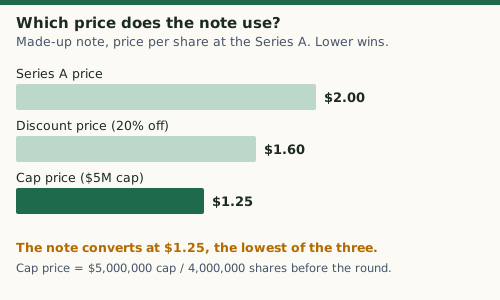
| Cap price: $5,000,000 ÷ 4,000,000 | $1.25 | $1.25 |
| Conversion price: the lesser of the two | $1.25 | $0.80 |
| Shares issued: $106,000 ÷ conversion price | 84,800 | 132,500 |
| Shares if there were no cap: $106,000 ÷ discount price | 66,250 | 132,500 |
Our arithmetic: at a $2.00 round the cap beats the discount, and the noteholder buys 84,800 shares, not 66,250. At a $1.00 round the company is worth less than the cap, so the discount price is lower and the cap is not used, which matches the clinic’s point that a cap far above the company’s value may never apply2.
Ownership after the $2.00 round (our arithmetic): if new investors put in $2,000,000 at $2.00, they receive 1,000,000 shares. Total shares are 4,000,000 + 84,800 + 1,000,000 = 5,084,800, so the note holds 84,800 ÷ 5,084,800 = about 1.67%. The effective price of $1.25 against $2.00 is a 37.5% reduction, which is why J.P. Morgan stresses that notes defer the pricing but not the dilution3.
Do you have to pay back a convertible note?
A convertible note is debt, so repayment is the default if the conversion never happens. The clinic’s model note makes principal and accrued interest payable on the request of the majority holders on or after a maturity date set at 24 months from the first closing2. Maturity is generally set at one or two years from issuance2, and J.P. Morgan puts the common range at 12-24 months3.
If the company has not raised a qualifying round by then, the holder may elect cash repayment or conversion into the company’s most senior class of stock2. In practice the two sides usually negotiate repayment, extension or conversion3. Cake Equity’s guide adds that startups often extend the maturity date to avoid defaulting4. A note approaching maturity without a financing event forces a negotiation the founder may not be positioned to win3.
Worked example (our arithmetic): the same note at maturity (simple interest as in2; made-up amounts)
| Line | Amount |
|---|---|
| Principal | $100,000 |
| Interest: 6% simple for 2 years | $12,000 |
| Due on request after 24 months | $112,000 |
Default has teeth. The clinic’s annotations add that default events allow the noteholder to order immediate repayment of any outstanding debt2. J.P. Morgan’s suggestion is to begin conversations with noteholders well before maturity, with a clear plan to convert or extend3.
What happens to a convertible note if the startup fails?
The noteholder ranks ahead of equity. Debt is repaid before any equity if the company is sold or wound down5. A SAFE issued before or after a note sits behind it in line5. The clinic’s model note is unsecured2, which means the holder has a claim on the company but not on a particular asset. If the company has little left, a senior claim over equity does not guarantee payment.
A sale before the qualified financing works the same way. Under the model note the investor receives cash equal to principal plus accrued interest instead of shares2. Thomson Reuters adds the investor’s view: the debt nature of the note lets an investor recover money as a creditor if the startup becomes insolvent7.
Convertible notes for investors
An investor holds three things at once: a creditor’s claim, a conversion right and, usually, a promise of a better price than new money gets. The discount and the cap are the compensation for taking the earlier risk7. The note carries none of an equity holder’s rights before conversion, including voting4. Interest matters less than conversion7.
The chapter on how venture rounds work covers the later round where the conversion lands.
Disadvantages of convertible notes
Most of the weaknesses show up for founders at conversion, and a few for investors earlier.
- Dilution is only postponed. Notes defer setting a valuation, not the dilution3.
- Debt has a deadline. An unpaid note falls due at maturity, and the company may have to repay, extend or convert on weaker terms3.
- Stacked terms. Each new note or SAFE with a different cap, discount or most-favored-nation clause adds conversion complexity that new investors must untangle3.
- Senior claims. A note issued under or over SAFEs ranks ahead of them5.
- Ownership uncertainty. Notes create uncertainty about future control and ownership, particularly when several notes convert at once7. Y Combinator also lists ownership as estimated until conversion5.
- Unintended outcomes. The clinic warns that notes can lead to outcomes the parties did not intend2.
Y Combinator calls notes increasingly rare for new raises5, a position from an accelerator that promotes the SAFE, not market data.
Real terms from an SEC filing: HeartFlow
Public filings show how the same terms look at larger scale. In its 2025 registration statement HeartFlow disclosed two note programs6.
| Term | 2022 notes | 2025 notes |
|---|---|---|
| Amount | $40.0 million6 | $98.3 million6 |
| Interest | 8% a year, compounded monthly6 | None for the first year, then 7.0% capitalized into principal6 |
| Maturity | September 30, 2026; no prepayment without majority consent6 | 48 months from issuance6 |
| Conversion | 67% of the round price in a financing of at least $100 million6 | At an IPO, the lower of a 20% discount and a $2.0 billion pre-money cap6 |
| Outcome | Converted in March 2023 into 21,465,064 Series F-1 preferred shares6 | Converts automatically at the IPO6 |
Two features stand out. Conversion price can be a percentage of the round price, as in 2022, or the lower of a discount and a cap, as in 20256. And HeartFlow remeasured the 2022 notes at fair value immediately before conversion and recognized a $5.1 million loss from the change in fair value6.
Convertible note vs SAFE
The SAFE came after the note as a simpler cousin. A SAFE is an agreement to buy shares later, with no interest and no deadline7; a convertible note is a loan with interest and a repayment deadline7. SAFE notes covers the other instrument in the same detail.
Education only: ranges differ by source, and other states, loan sizes and security structures change the answers above.
Common questions
What happens to a convertible note if startup fails?
The holder is a creditor, so the note ranks ahead of every share if the company is sold or wound down5. How much comes back depends on what is left, because the clinic's model note is unsecured2. Investors in an insolvent startup may recover part of the money as creditors7.
Do you have to pay back a convertible note?
Yes, unless it converts first. Once the maturity date passes without a round, the notes typically become due and payable4. The model note lets the holder choose repayment in cash or conversion2, and in practice the sides negotiate repayment, extension or conversion3.
What are the disadvantages of convertible notes?
They postpone the valuation but not the dilution3. A maturity date can force a negotiation the founder may not win, and notes with different caps and discounts complicate the cap table3. Who controls the company after conversion stays uncertain until it happens7.
Read next
Fundraising mechanics
SAFE notes: how they work, convert and what they risk
A SAFE is a contract for shares later, not a loan: how the valuation cap sets ownership, when it converts, how it differs from a note, and the risks.
Fundraising mechanics
How venture rounds work: seed to exit, step by step
How a startup funding round works: who invests at each stage, SAFEs and convertible notes, the Series A paperwork, investor rights and the ways a company exits.
Startup equity
Startup stock options: ISO vs NSO tax, 409A, Rule 701
How ISOs and NSOs are taxed at grant, exercise and sale, the $100,000 rule, AMT, how 409A sets the strike price, Rule 701 limits and Form 3921 reporting.
Sources
- Common Startup Securities · U.S. Securities and Exchange Commission · sec.gov · checked October 21, 2026
- Convertible Notes Overview (Startup Kit) · University of Pennsylvania Carey Law School, Entrepreneurship Legal Clinic · law.upenn.edu · checked October 21, 2026
- How Convertible Notes Work for Startups & Founders · J.P. Morgan · jpmorgan.com · checked October 21, 2026
- Convertible Notes: A Founder's Guide to Fast Startup Funding · Cake Equity · cakeequity.com · checked October 21, 2026
- SAFE vs. Convertible note vs. Priced Equity Round · Y Combinator · ycombinator.com · checked October 21, 2026
- HeartFlow, Inc. Form S-1/A, Amendment No. 2 (filed 2025-08-06) · U.S. Securities and Exchange Commission (EDGAR), filing by HeartFlow · sec.gov · checked October 21, 2026
- What is a convertible note? | Legal glossary · Thomson Reuters · legal.thomsonreuters.com · checked October 21, 2026
- 6 Del. C. Chapter 23, Interest (Delaware Code Online, Title 6) · State of Delaware · delcode.delaware.gov · checked October 21, 2026
Published . Rules and rates change: each source shows the day it was read. Education only, not advice. How we check facts · Report an error.