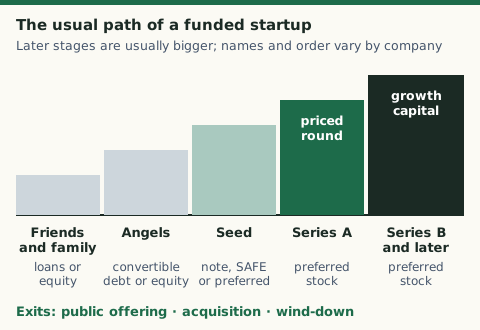
Every startup that takes outside money passes through the same legal gate before anything else. The company must sell its securities either under a registration or under an SEC-listed exemption1. The stages, the paper and the exits all sit on that one rule.
To keep the mechanics concrete, this story follows Lantern, a made-up software company, from its first check to a sale. Lantern’s figures are round numbers the editors chose, and every table built on them is marked as our own arithmetic. The page belongs to fundraising mechanics and is education, not a recommendation to raise money.
The rule underneath every round
Every offer and sale of securities must be registered under the Securities Act of 1933 or rely on an exemption from registration1, 5. That sounds abstract until you see how little the market’s vocabulary matters to it.
The industry names rounds by investor type or letter, but the federal securities laws do not differentiate in the same way.5
Whether Lantern’s first outside check is called friends and family, angel, seed or Series A, the company still has to fit the deal inside an offering exemption if it wants to avoid registering it4. The category that counts is the exemption, and the one used most often is Rule 506(b) of Regulation D5.
Friends and family, then angels
Lantern’s founders start where most founders do: their own savings, then people who already know them4. Because the relationship is close, the founders should spell out the risks, including what happens if the company fails4. These deals join at pre-seed or seed and run the smallest of any stage, around $10,000 to $50,000, as loans, convertible debt or equity4. The pre-seed round is the earliest infusion of capital, used to launch the company, build a prototype and look for early product-market fit11.
Angels come next. They are high-net-worth individuals investing their own money directly in emerging businesses, and they tend to syndicate, pooling $200,000 to $400,000 per deal. In 2024 they put over $17.9 billion into early-stage companies4. Equity crowdfunding is also emerging as an option at this stage12.
The seed round: notes, SAFEs and the first priced deal
Seed is often the first formal equity round with an institutional lead, and it takes one of two shapes. It can be priced, with investors buying preferred stock at a valuation the lead sets. Or it can be a convertible note or a simple agreement for future equity that converts later11. A company this young is hard to value, so founders at this point usually want to postpone that argument, and the second shape lets them.
Convertible notes
A convertible note is a loan that can convert into a different security3. Seed investors use it often because a young company is hard to value and the note puts that argument off. Typically the note converts from debt into preferred stock automatically when the next funding round closes, or on other agreed conditions3.
SAFEs
A SAFE is a short contract. The investor funds the startup now in exchange for the right to shares later, and the SAFE converts automatically when the startup raises a priced round9. Until that trigger the holder owns no part of the company, and unlike a note a SAFE usually carries no valuation at issue, so the company defers that arithmetic3.
On Y Combinator’s standard form one term is usually left to negotiate: the valuation cap, the highest valuation at which the SAFE converts into shares9. The ownership the company sells equals the investment divided by the cap. Y Combinator’s example is a $1M raise for 15% ownership, which gives a post-money cap of $1M ÷ 15% = ~$6.7M9. The discount is the second lever. With a 20% discount, SAFE investors pay 20% less than the new investors do in the priced round9. The post-money SAFE has been the Y Combinator standard since 20189.
SAFE or note: where the arithmetic differs
The difference that matters is debt. A convertible note is debt: interest accrues and the note has a maturity date set for repayment or forced conversion9. A SAFE is not debt, has no interest or maturity date, and is therefore simpler, faster and cheaper to sign9. The conversion math follows from that. A note converts what the investor lent plus the interest that built up, while a SAFE converts only what went in. Discounts are commonly 10–20%17.
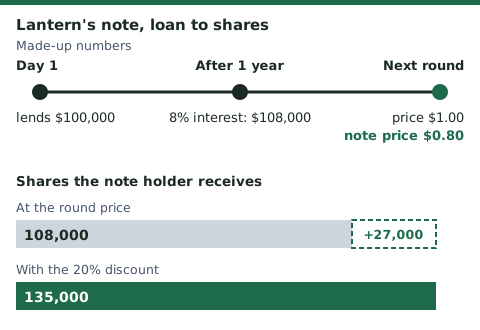
Say a friend lends Lantern (our made-up company) $100,000 on a note at 8% simple interest, and a year later the next round prices shares at $1.00 with a 20% discount for the note holder.
Our arithmetic: Lantern’s note at conversion (discount rule from9)
| Line | Amount |
|---|---|
| Loan | $100,000 |
| Interest, 8% simple, 1 year | $8,000 |
| Note at conversion | $108,000 |
| Next round price per share | $1.00 |
| Discount for the note holder | 20% |
| Conversion price9 | $1.00 × 0.80 = $0.80 |
| Shares issued | $108,000 ÷ $0.80 = 135,000 |
| Same dollars at the round price | 108,000 shares, so the discount adds 27,000, a quarter more |
When a cap and a discount both apply
Many SAFEs carry both, and whichever calculation is most advantageous to the investor applies16. The cap becomes a price per share, the Safe Price, which is the valuation cap divided by the Company Capitalization16. The investor then takes the lower of that price and the discounted round price, because a lower price buys more shares.
Suppose Lantern had raised $500,000 on a SAFE with a $9M cap and a 20% discount instead. We hold capitalization at 10,000,000 shares to keep the arithmetic readable. A real conversion also counts the SAFEs, the options and the pool, so read the result as a sketch. The table runs that one SAFE through a modest round and a hot one.
Our arithmetic: one SAFE, two rounds (cap and discount rule from16)
| Step | Round priced at $1.00 | Round priced at $2.00 |
|---|---|---|
| Cap price: $9,000,000 ÷ 10,000,00016 | $0.90 a share | $0.90 a share |
| Discount price: round price × 0.80 | $0.80 | $1.60 |
| Lower price applies16 | $0.80, the discount | $0.90, the cap |
| Shares: $500,000 ÷ price | 625,000 | 555,556 |
A modest round makes the discount do the work, and a hot round makes the cap do it.
How a round runs, step by step
Seed money buys time. When Lantern is ready for a bigger, priced round, a lead investor sets the pace: usually the best-known or most aggressive venture firm in the round, or the one writing the largest check11. From there the round follows a familiar sequence.
- Introduction and offering. Investors and companies find each other through networks and warm referrals, because no public exchange lists these securities11.
- Term sheet. The parties agree the main terms and sign a term sheet as an expression of commitment11.
- Definitive documents. Lawyers negotiate and draft the contracts that carry out the deal11.
- Due diligence. The investors examine the financial statements, books and records, and every aspect of operations11.
- Closing. Investors fund and the company issues shares. Some deals come in tranches, with the rest of the money released when the company hits agreed milestones11.
Diligence can end in homework: investors may require fixes before they agree, such as new employment contracts or vesting schedules for key executives. At closing the company gives representations and warranties about the accuracy of its disclosures, and any outstanding convertible notes may convert at or after the close11.
Nobody drafts the documents from scratch. The NVCA Model Legal Documents are the industry-embraced starting point for venture financings, covering the Certificate of Incorporation, Stock Purchase Agreement, Investors’ Rights Agreement, Voting Agreement and Right of First Refusal and Co-Sale Agreement10. The updated set adds mechanics for tranched financings, and the NVCA itself calls each document a starting point only, to be tailored to the deal10.
Other securities on the cap table
A round is not the only way shares get issued. Startups also grant options and restricted stock to employees, and an LLC has membership interests instead of shares3. Options get their own treatment in the equity and finance team section, starting with startup stock options, including how the strike price is set. Debt can count as a security too, depending on its type3.
Series A funding: from pre-seed to the first priced round
A priced equity round is often called Series A, and each later round takes the next letter11. It is the first institutional venture round meant to fund growth, and together with seed it makes up early-stage funding, which companies use to find product-market fit12.
Valuations have not just recovered from the 2022-to-2023 correction; they have pushed past their 2021 highs13. The median pre-money valuation more than doubled relative to 2021 at pre-seed, seed and Series D+13. Treat that as a reading of the market from one report, as of June 30, 2026, and not as a target. The post-money valuation is usually the highest mark in the round and is not the price every investor pays13.
This is also where the paper changes character. In the stock purchase agreement, investors exchange money for newly created preferred stock11. Founders usually hold common stock and outside investors hold preferred, and the two classes carry different voting and economic rights3. Because of regulatory requirements, most venture capital investments are structured as equity such as preferred stock4.
Pre-money, post-money and dilution: one round worked through
Every priced round starts with two valuations. A pre-money valuation is the value of the company immediately before it receives the investment, and a post-money valuation is the value immediately after9. The two differ by exactly the new money.
Y Combinator shows the link with a SAFE. A target of a $1M raise for 15% ownership gives a post-money cap of about $6.7M, which it writes as “$1M at $6.7M post / $5.7M pre”9. Raise less on that cap and you sell less: $500k on a $6.7M post-money cap is about 7.5%, and $1M is about 15%9.
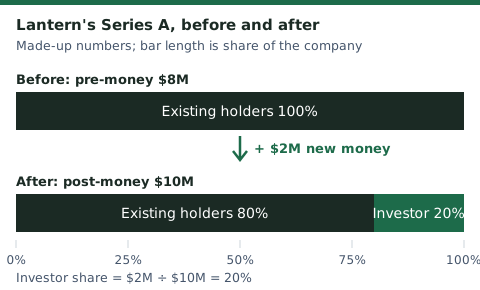
Lantern’s Series A lead offers $2,000,000 at an $8,000,000 pre-money valuation. The question is what the lead owns afterwards and what the existing holders keep.
Our arithmetic: Lantern’s Series A (pre- and post-money definitions from9)
| Line | Amount |
|---|---|
| Pre-money valuation | $8,000,000 |
| New money | $2,000,000 |
| Post-money valuation9 | $10,000,000 |
| Investor ownership9 | $2,000,000 ÷ $10,000,000 = 20% |
| Existing holders | 100% before, 80% after |
Nobody lost value in the swap. The people who held the company before gave up a fifth of the ownership in exchange for cash in the bank, and that give-up is dilution.
Early investors usually want to keep their stake in the next round. Pro rata rights let an investor put money into a future equity financing to keep their ownership percentage from shrinking9.
The option pool shuffle
An option pool is a block of shares reserved for future hires. When a round creates the pool at the same moment it brings in the investor, someone has to decide whose stake pays for it. Y Combinator’s SAFE draws the line like this: the post-money cap counts the options and pool that exist before the equity financing, and does not count the new or increased pool adopted as part of it9. In plain terms a pool created inside the round dilutes the people who held stock before it, and the new investor does not share the cost.
Now suppose Lantern’s lead asks for a 10% pool, sized on the post-money company and set up before the money goes in. The founders feel it immediately.
Our arithmetic: Lantern’s pool (pool rule from9)
| Holder | Share of the post-money company |
|---|---|
| Investor | 20% |
| Option pool (sized at 10% of post-money)9 | 10% |
| Existing holders | 70%, against 80% without the pool |
What preferred stock gives investors
Four terms decide most of what an investor receives beyond shares, and the NVCA model Certificate of Incorporation and Voting Agreement show how each is written.
The first is the liquidation preference. Preferred holders are paid before any payment to common holders, in an amount per share equal to the greater of a multiple of the original issue price plus declared dividends, or what they would get had they converted to common14. In a sale at a low price, that can leave little or nothing for common holders. The second is participation. Where preferred is participating, holders take the multiple of the original issue price first and then share what remains pro rata with common as if converted14. The investor is paid twice, so more of a sale goes to preferred.
The third is anti-dilution protection. If the company later sells stock below the series’ conversion price, the conversion price is reduced by a formula14, and a down round shifts ownership toward the earlier investors. The fourth is governance: the holders of the preferred stock, as a separate class, elect a preferred director15. Investors taking part in governance is normal for VC funds, often as a seat on the board or advisory board4.
The preference at three sale prices
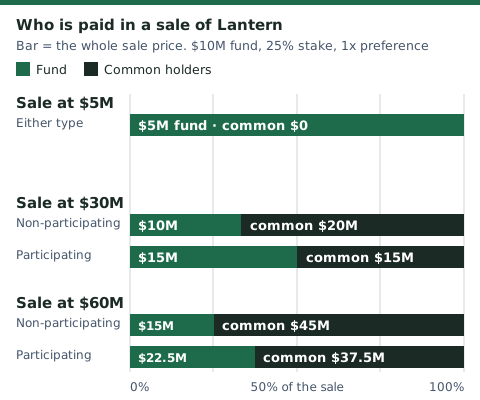
Say a fund put $10M into Lantern’s Series A for 25% of the company, in preferred stock with a 1x preference. Three exits are on the table: $5M, $30M and $60M. The table shows who gets what under each preference type.
Our arithmetic: three sales of Lantern (preference terms from14)
| Sale price | Non-participating: fund | Non-participating: common | Participating: fund | Participating: common |
|---|---|---|---|---|
| $5M | $5.0M | $0 | $5.0M | $0 |
| $30M | $10.0M | $20.0M | $15.0M | $15.0M |
| $60M | $15.0M | $45.0M | $22.5M | $37.5M |
In the middle row the non-participating fund keeps its preference, because converting to common would pay it less. In the bottom row converting pays more, so it converts. The participating fund takes its preference first and then its share of what is left, so it collects more in every sale above the preference.
Broad-based weighted-average anti-dilution
In a down round the earlier investors’ conversion price falls in proportion to how many cheap shares were sold. The NVCA charter offers a broad-based weighted-average formula, and full ratchet as the alternative a term sheet may call for14. In the weighted-average version the conversion price after a lower-priced issue is CP2 = CP1 × (A + B) ÷ (A + C), where CP1 is the price in effect before, A is the common stock outstanding on a fully diluted basis, B is the number of shares the new money would have bought at CP1, and C is the number of shares actually issued14.
Two years later Lantern stumbles and has to raise at a lower price than the Series A paid. It sells 2,000,000 new shares at $0.50 for $1,000,000, and the Series A converts at $1.00 with 10,000,000 shares outstanding on that basis.
Our arithmetic: Lantern’s down round (formula from14)
| Quantity | Value |
|---|---|
| CP1, the price in effect before14 | $1.00 |
| A, shares outstanding | 10,000,000 |
| C, shares actually issued | 2,000,000 |
| B, shares the new money would buy at CP1: $1,000,000 ÷ $1.0014 | 1,000,000 |
| CP2 = $1.00 × (10,000,000 + 1,000,000) ÷ (10,000,000 + 2,000,000)14 | $1.00 × 11 ÷ 12 = $0.9167 |
| Series A holder, $1,000,000 invested at $1.00, before | 1,000,000 shares |
| Same holder after weighted average: $1,000,000 ÷ $0.9167 | 1,090,909 shares |
| Same holder after full ratchet, price reset to $0.50: $1,000,000 ÷ $0.50 | 2,000,000 shares |
The gap between those two share counts is why founders negotiate this term.
Who is allowed to invest
Many exemptions limit participation to accredited investors or restrict non-accredited ones7. For an individual, one route is financial: a net worth over $1 million excluding the primary residence, or income over $200,000 (or $300,000 with a spouse or partner) in each of the prior two years with the same expected this year7. Directors and executive officers of the company selling the securities also qualify7.
Under Rule 506(b) a company can raise an unlimited amount from an unlimited number of accredited investors, with two limits: no general solicitation, and no sales to more than 35 non-accredited investors in any 90-calendar day period2. Rule 506(c) permits general solicitation where every purchaser is accredited and the issuer takes reasonable steps to verify it1. Rule 504 allows up to $10 million of securities in a 12-month period1.
After the first sale the company files a notice on Form D within 15 days, with no filing fee, and state regulators can still require their own notices and fees1, 2. One ineligible purchaser can taint the round: if a company offers securities to even one person who does not meet the conditions, the entire offering may violate the Securities Act2.
Round names you will meet
Venture rounds are named after the class of stock being sold11. A letter with a prime mark, such as Series A’, is a small follow-on or bridge round folded into the one before, generally on the same terms. Series AA was once used for a new start after a crunch-down or down round. A pre-IPO round is a late-stage equity round that raises money ahead of a listing, and mezzanine rounds, bridge loans and other debt carry a company between venture rounds or up to its IPO11.
Round count is itself a signal. Investors can worry when a company has raised too much in too many rounds, since it can look like delayed progress11.
Stage by stage
| Stage | Typical investor | Typical form | Reference point |
|---|---|---|---|
| Friends and family | People who know the founders4 | Loans, convertible debt or equity4 | Around $10,000 to $50,000 per deal4 |
| Angel | High-net-worth individuals, often syndicated4 | Convertible debt or equity4 | $200,000 to $400,000 per deal4 |
| Seed | Institutional lead or angels11 | Priced preferred stock, note or SAFE11 | Convertible instruments put off the valuation question3 |
| Series A | Venture capital funds4 | Preferred stock4 | Used to find product-market fit12 |
| Series B and later | Venture and growth investors12 | Preferred stock4 | Board seats and operational oversight may be expected5 |
Later rounds: Series B, C and growth capital
Once a company has found product-market fit it uses growth capital to scale, which typically means Series B, Series C and later rounds12. Investors at this point may expect operational oversight, one or more board seats and a bigger say in strategy5.
VC funds invest across the life cycle, from Series A through the public offering, and many invest repeatedly in the same companies4. A fund is typically built to last at least ten years, with the first few years spent investing4. Venture investment grew from approximately $164 billion in 2023 to approximately $215 billion in 2024, and those investments are generally locked in until a liquidity event4. Bridge financing is funding a startup seeks between full VC rounds12.
Before a later round the company weighs how much to raise, what securities to offer, how many board seats to give and which existing owners will be diluted5. An employee equity plan belongs on that list, because securities issued under it dilute owners as well5.
Exits: how the story ends
Securities of a private company can be resold to another investor only if the resale is registered or fits an exemption, such as the Rule 144 safe harbor6. That is why exits matter: they are how illiquid shares become cash.
For Lantern there are three endings. A public offering is one: a startup can list through an IPO, a merger with a special purpose acquisition company or a direct listing, and some investors’ shares may be subject to a lockup that delays selling6. To go public the company must file a registration statement and may not sell until the SEC staff declares it effective, after which the company is subject to Exchange Act reporting8. A sale is another: a startup can sell to another company or investor6. The third is the one nobody plans. If a company shuts down it sells its assets and returns what is left to shareholders in order of liquidation preference6, and that is where the preference clauses above do their work.
Common mistakes in reading a round
Five mistakes come up again and again. One is reading round names as law, when the securities laws care about which exemption the deal fits and not whether it is called seed or Series A4, 5. Another is treating a SAFE as equity, although the holder owns nothing until a triggering event converts it3. A third is treating the term sheet as the finished deal, when the definitive documents carry many important details beyond the major deal terms11. A fourth is copying model documents unchanged, although the NVCA calls them a starting point only10. The fifth is missing the notice filings: Form D is due within 15 days of the first sale, and states can add their own2.
None of this replaces a securities lawyer. A lawyer applies these rules to a specific company, which this page cannot do.
If this left you with a question, start with SAFE notes: how they work, convert and what they risk or Convertible notes: how they work, terms and example.
Sources
- Exempt Offerings · U.S. Securities and Exchange Commission · sec.gov · checked October 21, 2026
- Private Placements - Rule 506(b) · U.S. Securities and Exchange Commission · sec.gov · checked October 21, 2026
- Common Startup Securities · U.S. Securities and Exchange Commission · sec.gov · checked October 21, 2026
- Early-Stage Investors · U.S. Securities and Exchange Commission · sec.gov · checked October 21, 2026
- Raising Later-Stage Capital · U.S. Securities and Exchange Commission · sec.gov · checked October 21, 2026
- Exit Strategies and Liquidity · U.S. Securities and Exchange Commission · sec.gov · checked October 21, 2026
- Accredited Investors · U.S. Securities and Exchange Commission · sec.gov · checked October 21, 2026
- Going Public · U.S. Securities and Exchange Commission · sec.gov · checked October 21, 2026
- The SAFE: The standard way startups raise money · Y Combinator · ycombinator.com · checked October 21, 2026
- Model Legal Documents · National Venture Capital Association (NVCA) · nvca.org · checked October 21, 2026
- Venture round · Wikipedia · en.wikipedia.org · checked October 21, 2026
- Venture capital · Wikipedia · en.wikipedia.org · checked October 21, 2026
- PitchBook-NVCA Venture Monitor, Q2 2026 · PitchBook and National Venture Capital Association (data as of June 30, 2026) · nvca.org · checked October 21, 2026
- NVCA Model Certificate of Incorporation (updated October 2025) · National Venture Capital Association (NVCA) · nvca.org · checked October 21, 2026
- NVCA Model Voting Agreement (updated June 2026) · National Venture Capital Association (NVCA) · nvca.org · checked October 21, 2026
- SAFE User Guide (post-money safe) · Y Combinator (guide dated February 2023) · bookface-static.ycombinator.com · checked October 21, 2026
- SAFE vs. Convertible Note · Y Combinator · ycombinator.com · checked October 21, 2026
Published . Rules and rates change: each source shows the day it was read. Education only, not advice. How we check facts · Report an error.