A SAFE is the paperwork a founder most often meets first when an investor offers money before there is a priced round. This page covers the terms of the standard Y Combinator forms, the arithmetic that turns a valuation cap into a percentage, what happens at each trigger, and where the instrument can hurt either side. It belongs to the fundraising mechanics section, it describes United States practice, and it is education, not legal or tax advice.
What a SAFE note is
A SAFE is an agreement in which the company promises the investor a future ownership interest if certain triggering events occur, such as a future equity financing or an acquisition of the company5. Until a trigger occurs the investor owns no part of the company5. Unlike a convertible note, a SAFE generally does not put a valuation on the equity when it is issued, deferring that calculation until the triggering event5.
The label misleads. Despite the common phrase “SAFE note,” the instrument is not a loan, and it is not stock until it converts into preferred shares in an equity financing1. Y Combinator introduced the original version in late 2013 as a replacement for convertible notes in early fundraising2. In 2018 it moved to a post-money version, treating SAFE-based financings as independent seed rounds capable of providing multi-year runways, rather than short bridges to a priced round2. That post-money form has been the standard since 20181.
Founders and investors usually have one item left to negotiate: the valuation cap2. That is the main reason the SAFE spread. A company can close with one investor as soon as both sides sign and the money arrives, without lining up a single close for everyone, and without paying lawyers to draft a long set of terms2.
How a SAFE works, from signing to shares
The mechanics are short enough to list.
- Agree two numbers. The investor and the company settle on the amount invested and the valuation cap, then both date and sign the SAFE2.
- The money arrives. A SAFE is not binding until the money is received, so an unfunded SAFE never takes effect1.
- Nothing happens, technically. The SAFE sits outstanding until a priced round, a sale of the company or a dissolution occurs2. Y Combinator strongly recommends keeping an accurate cap table that tracks how each SAFE will convert2.
- A priced round converts it. When the company sells preferred stock in an equity financing, every outstanding SAFE converts automatically and then terminates, with no minimum amount that the round must raise1.
- The holder becomes a stockholder. The SAFE is designed to turn its holder into a stockholder, and it ends once it has paid out in stock, cash or other proceeds2.
Behind step 4 sits a board decision. The company’s board of directors must formally consent to issuing SAFEs, at a meeting or in writing, before any are issued2. The standard forms also restrict transfer: the investor cannot pass a SAFE to anyone but an affiliate without the issuing company’s consent1.
SAFE terms, defined
Six terms carry almost all of the meaning in a standard SAFE. The table gives each one in plain words, with the arithmetic that follows from it.
| Term | What it means | What it does to ownership |
|---|---|---|
| Valuation cap | The highest valuation at which the SAFE converts1 | A priced round above the cap converts the SAFE at the cap, which rewards the early investor1 |
| Discount | A lower price than the next round’s; at 20%, SAFE investors convert at a price per share 20% below the equity financing’s1 | Discounts are commonly 10–20%1 |
| Post-money SAFE | A cap stated as the valuation after the investment is made, counting all SAFE money1 | Ownership sold equals the amount invested divided by the cap1 |
| MFN (most favored nation) | No cap and no discount; it automatically takes the cap or discount of any SAFE issued later1 | Takes the better terms of any SAFE issued later, so sequence matters3 |
| Pro rata rights | The right, not the obligation, to invest in a future round to keep a percentage1 | Lives in an optional side letter, not in the SAFE1 |
| Conversion | The automatic change from SAFE into preferred stock at a priced round1 | The SAFE then ends1 |
Two of these deserve a closer look. A SAFE can carry a cap and a discount at once, and then whichever calculation is most advantageous to the investor applies2. A discount works like this: the Discount Rate is 100 minus the discount percent, so a 20% discount means a Discount Rate of 80%2. The MFN has a timing rule: the date it uses is the later of signing the SAFE or receiving the wire1. An MFN holder gets one chance to adopt later terms, and it cannot cherry-pick: if it converts to a later SAFE’s terms, the amended SAFE is identical to that later one2.
The valuation cap and how much ownership it sells
The cap is the number everyone argues about, and on a post-money SAFE it translates directly into a percentage. The rule is a division: ownership sold equals the investment divided by the post-money cap1.
Pick the fundraise amount and the valuation cap follows
Y Combinator’s own example starts from a target. A founder aiming to raise $1 million and sell 15% sets a post-money cap of about $6.7 million, because $1 million ÷ 15% is about $6.7 million2. Raise less on the same cap and you sell less: $500k on a $6.7M cap is about 7.5%, and $1M is about 15%1.
Pre-money and post-money, side by side
Pre-money and post-money are two ways to describe one valuation at two moments. A pre-money valuation is the valuation immediately before the company receives the investment2. A company raising $2 million at a $10 million pre-money valuation is generally raising at $12 million post-money2.
Several caps add up
Caps add up, which is the point of the post-money design. Five $100k SAFEs at a $5M cap sell 10% of the company, not 2%3. A company that raises on different caps simply sums the percentages. Y Combinator’s two-cap example: $500k on a $5.5 million cap sells about 9%, $500k on an $8.3 million cap sells about 6%, and together they sell about 15%2.
The ceiling on a post-money SAFE
The same division sets a hard limit. Raising more than the post-money cap would result in negative ownership for founders2. The guide’s own table makes the point at a $5 million cap: raising $2.5 million sells 50% and leaves founders 50%2. Long before that ceiling, founders have to weigh the next round’s dilution, because SAFE ownership is measured before the new money arrives.
A SAFE note example, step by step
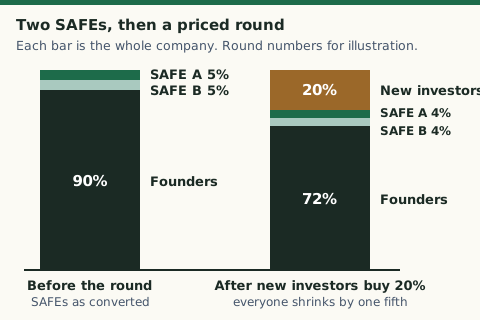
Here is the full path with round numbers. Harbor is our made-up company, owned entirely by its founders. It signs two SAFEs with different caps. The first is for $200,000 on a $4,000,000 post-money cap, the second for $400,000 on an $8,000,000 cap. We apply the division rule from1 to each.
Worked example (our arithmetic): Harbor’s two SAFEs (ownership rule from1)
| SAFE | Purchase amount | Post-money cap | Ownership sold |
|---|---|---|---|
| Investor A | $200,000 | $4,000,000 | $200,000 ÷ $4,000,000 = 5%1 |
| Investor B | $400,000 | $8,000,000 | $400,000 ÷ $8,000,000 = 5%1 |
| Together | $600,000 | 5% + 5% = 10%, so founders hold 90%3 |
Some time later Harbor raises a priced Series A, and new investors buy 20% of the company after closing. For a clean illustration we assume no option pool change and no pro rata rights. The SAFEs convert into preferred stock, and because they are measured before the new money, every holder is diluted by the new round: the safes are not diluted by each other, but they are diluted by the money raised in the equity financing2.
Worked example (our arithmetic): Harbor after the Series A. Every holder shrinks by the 20% the new investors take, so each after-round figure is the old figure × 0.80 (dilution rule from2). The new investors hold the rest.
| Holder | Before the round | After the round |
|---|---|---|
| Founders | 90% | 90% × 0.80 = 72%2 |
| SAFE investor A | 5% | 5% × 0.80 = 4%2 |
| SAFE investor B | 5% | 5% × 0.80 = 4%2 |
A real conversion is messier, because the cap table also counts the options and the unissued pool that exist before the round, and it leaves out any pool increase adopted as part of the round2. Y Combinator’s own worked example adds up the dilution from SAFEs, new hires’ options and the Series A: safe dilution of 15% × (100% − 39.41%) = 9.09% in its illustration2. The full formulas live in the cap table section of the User Guide2.
Why the cap sometimes does not apply
The cap is a ceiling on the conversion price, not a promise of a price. The SAFE holder’s ownership will be the greater of what the cap implies and what the investment buys at the price new investors pay2. A cap is a ceiling on the price, not a final valuation2. When the round values the company well above the cap, the cap applies. When the round’s valuation is close to or below the cap, the holder converts at the new investors’ price and can end up with more shares than the cap-based estimate predicted2. Founders then take more dilution than they estimated2.
What is a trigger event for a SAFE: priced round, sale or shutdown
The SEC investor bulletin of May 9, 2017 explains why triggers matter: a SAFE gives the investor a future equity stake only if a triggering event occurs4.
A SAFE has three trigger events, and each one pays differently. The table covers the standard valuation cap form.
| Event | What happens to the SAFE | Where it ranks |
|---|---|---|
| Priced round (equity financing) | Converts automatically into preferred stock1 | Becomes stock1 |
| Acquisition or IPO (a Liquidity Event) | The investor gets the greater of 1x their money back or the as-converted amount1 | Behind debt, on par with preferred stock1 |
| Shutdown (a Dissolution Event) | The investor gets the SAFE purchase amount back1 | Behind debt, on par with preferred stock1 |
In a liquidity or dissolution event the SAFE functions like standard non-participating preferred stock: it ranks junior to outstanding debt, including convertible notes, on par with other SAFE holders and preferred stockholders, and senior to common stockholders2. The SAFE is designed to end only once the holder has received stock, cash or other proceeds2.
That design has a gap the SEC flagged. A SAFE may never trigger. If the company earns enough that it never again needs to raise capital, and is never acquired, the SAFE may never convert4. And a SAFE that triggers on an offering of preferred stock does not convert if the company later raises money by selling more SAFEs, common stock or convertible notes, or by taking a conventional bank loan4. In both cases the investor can be left holding nothing despite the company having raised more capital4.
SAFE vs convertible note
Both instruments convert into equity later, so the difference is what they are before they convert. A convertible note is a loan made by an investor to a company that can be converted into a different security5; the SEC’s startup securities primer draws the same line. It accrues interest and carries a maturity date set for repayment or forced conversion1. A SAFE has neither1.
| SAFE | Convertible note | |
|---|---|---|
| What it is | A contract for future shares1 | A loan that can convert5 |
| Interest | None3 | Accrues, often 2–8%3 |
| Maturity date | None3 | Yes; it can force repayment or default3 |
| Ownership clarity | Precise once the post-money SAFE is issued3 | Estimated until conversion3 |
| In a liquidation | Junior to debt, on par with preferred stock3 | Senior: debt is repaid first3 |
| Legal cost | Lowest: one document3 | Moderate3 |
The seniority row has a trap. A convertible note is debt, and debt is senior to equity, including convertible equity like a SAFE3. Issue a note before or after a SAFE and the SAFE investors automatically sit behind it in line3. That is why mixing the two is generally not advisable: they are treated differently in a liquidation or dissolution event2. A company that already has many notes outstanding usually stays on notes for simplicity2.
Pre-money and post-money SAFEs
Y Combinator replaced the original pre-money SAFE with a post-money version in 20182. The change answers one question that the original could not: how much of the company a given investment buys2. Under the original, the answer depended on how much was raised on other SAFEs and on a hypothetical option pool increase negotiated years later2. With a post-money SAFE, calculating dilution and ownership takes little more than addition and division2.
The two versions also count different things when they convert. The post-money form includes other SAFEs and convertible notes in the capitalization and excludes the option pool increase from the round; the original excluded the SAFEs and included the pool increase2. Mixing the two forms creates cap table uncertainty, and the company then has to model every conversion2. Y Combinator treats pre-money SAFEs as legacy3.
Side letters, add-ons and amendments
The standard SAFE stays unmodified, and agreed extras go in a separate side letter1. The standard one is the pro rata letter, which gives the holder the right to invest in the priced round that converts the SAFE2. It works with SAFEs that have a post-money valuation cap, because the holder’s share is computed from the cap2.
Pro rata rights cost the founders dilution later. The company must make room in the equity financing for its new investors, for its existing investors with pro rata rights and perhaps for others2. Y Combinator’s formula for the extra ownership: with new investors targeting 25%, and SAFEs holding 15% as converted, the safe pro rata allocation is 25% ÷ (100% − 15%) − 25% = 4.41%2.
Other changes are simple. An investor who wants to put in more money gets a separate new SAFE on the same terms, which leaves the first one intact1. A SAFE can be amended with the written consent of the company and the investor, or of the company and a majority-in-interest of all outstanding SAFEs with the same terms, and nobody’s purchase amount changes without that investor’s consent2. A SAFE signed but never funded does nothing1.
What are the risks of SAFE notes?
The risks differ by side of the table.
For the investor. The SEC’s bulletin of May 9, 2017 was written about crowdfunding, but its list applies to any holder4. Despite its name, a SAFE may not be “simple” or “safe”4. The most important point is that the holder is not getting an equity stake in return4. SAFEs do not represent current equity stakes in the company, so they do not carry voting rights like common stock4. The bulletin names conversion terms, repurchase rights, dissolution rights and voting rights as the items to read4. On repurchase, the question is whether a provision lets the company repurchase the holder’s future right to equity instead of letting it convert4. The SEC adds that terms vary: there is nothing standard or simple about a SAFE, from the triggering events to the conversion price4. Y Combinator’s forms are standardized, but that standardization holds only while nobody edits them, which is why the form itself carries a statement that it is unmodified2.
For the founder. Three risks are arithmetic. Caps add up, so the running total of ownership sold has to be tracked before the next SAFE is signed3. The estimate can be wrong in the founder’s disfavor when the priced round does not sufficiently exceed the cap2. And an MFN signed first picks up a lower cap issued later, so sequence matters3. Two risks are legal. SAFE investors should be accredited, and if an investor is not accredited at the time of the equity financing, the company can rescind the SAFE by returning the money1. Pro rata letters can leave less room in the round than founders expected2.
For the accounts. Y Combinator intends the SAFE to be an equity security, and says the tax characterization is a question for a tax adviser2. Financial statements can go the other way, as the next section shows.
How companies account for SAFEs
SAFEs sit awkwardly between debt and equity, and public filings show it. Ventyx Biosciences accounted for its SAFEs as a liability under ASC 480, “Distinguishing Liabilities from Equity”, stated at fair value based on Level 3 inputs7. In its annual report the company judged one SAFE not to be legal-form debt, but the SAFE allowed redemption on events outside the company’s control7. The SAFE was measured at fair value at issuance and each reporting period, with changes in fair value in the statement of operations7. Upon dissolution, the holders could have received cash equal to the purchase amount7. That SAFE later converted into 555,297 shares of A-1 Convertible Preferred Stock, issued in February 20217.
Mobix Labs reached the same classification for its own SAFEs. They required cash settlement in some circumstances, such as a liquidation or dissolution, and the company recorded them as liabilities at fair value, then remeasured at each reporting date8. Both are single-company judgments about specific terms, not a rule for every SAFE, but they explain why a founder whose SAFE is described as equity in the term documents may still see a liability line in the audited accounts.
Who can invest and how the sale is regulated
Selling a SAFE is selling a security. A company must either register the offering or fit it within an exemption, and a SAFE is no different from a priced round on that point9. The most commonly used route is Regulation D, selling to accredited investors9. Most angel investors are accredited9.
Two Regulation D routes matter. Under Rule 506(b), there may be no more than 35 purchasers in any 90-calendar-day period, and each purchaser who is not accredited must, alone or with a purchaser representative, have the knowledge and experience to evaluate the merits and risks6. Under Rule 506(c), all purchasers must be accredited investors6. The company must also take reasonable steps to verify that they are6. The full text of Rule 506 sets the conditions6. Y Combinator’s guidance is that SAFE investors should be accredited1.
Questions the paperwork has to answer
Before a SAFE is signed, the form on the table should answer these, and the forms from Y Combinator already answer most of them.
- Which version is it: valuation cap, discount, or MFN with neither1?
- Is the cap stated before or after the investment, so what ownership does the amount buy2?
- What happens in a sale, an IPO or a shutdown1?
- Does the investor get a pro rata side letter, and on what minimum investment2?
- Is any other debt or SAFE outstanding that ranks ahead or changes the cap table2, 3?
- Has the board approved the issuance, and is the investor accredited1?
Round structure, the Series A paperwork and the exits that end a SAFE are covered in how venture rounds work. Options that dilute the same cap table are covered in startup stock options.
Common questions
Can an LLC issue a SAFE note?
The standard forms are written for corporations: they convert into preferred shares, and the online tool supports only US-incorporated companies1. An LLC has membership interests, not shares5. Whether an LLC can use a SAFE-style contract is a question for a lawyer in the state where it was formed.
Read next
Fundraising mechanics
How venture rounds work: seed to exit, step by step
How a startup funding round works: who invests at each stage, SAFEs and convertible notes, the Series A paperwork, investor rights and the ways a company exits.
Startup equity
Startup stock options: ISO vs NSO tax, 409A, Rule 701
How ISOs and NSOs are taxed at grant, exercise and sale, the $100,000 rule, AMT, how 409A sets the strike price, Rule 701 limits and Form 3921 reporting.
Fundraising mechanics
Convertible notes: how they work, terms and example
How a startup convertible note works: interest, maturity, discount, valuation cap, what happens if the company fails, plus a worked example and SEC-filed terms.
Sources
- The SAFE: The standard way startups raise money (valuation cap, discount, MFN, FAQ) · Y Combinator · ycombinator.com · checked October 21, 2026
- Post-Money SAFE User Guide and Quick Start Guide · Y Combinator · bookface-static.ycombinator.com · checked October 21, 2026
- SAFE vs. Convertible note vs. Priced equity round · Y Combinator · ycombinator.com · checked October 21, 2026
- Investor Bulletin: Be Cautious of SAFEs in Crowdfunding (May 9, 2017) · U.S. Securities and Exchange Commission, Office of Investor Education and Advocacy · investor.gov · checked October 21, 2026
- Common Startup Securities · U.S. Securities and Exchange Commission · sec.gov · checked October 21, 2026
- 17 CFR 230.506, Exemption for limited offers and sales without regard to dollar amount of offering · Electronic Code of Federal Regulations (U.S. Government) · ecfr.gov · checked October 21, 2026
- Ventyx Biosciences, Inc. Form 10-K for the fiscal year ended December 31, 2022 · Ventyx Biosciences, Inc. (SEC filing) · sec.gov · checked October 21, 2026
- Mobix Labs, Inc. Form 10-K for the fiscal year ended September 30, 2024 · Mobix Labs, Inc. (SEC filing) · sec.gov · checked October 21, 2026
- Early-Stage Investors · U.S. Securities and Exchange Commission · sec.gov · checked October 21, 2026
Published . Rules and rates change: each source shows the day it was read. Education only, not advice. How we check facts · Report an error.