On this page
- Key differences between ARR and MRR
- What is Monthly Recurring Revenue (MRR)?
- What is ARR, and why does it have two meanings?
- How to calculate ARR: the formula and a worked example
- When to use ARR vs MRR
- ARR vs revenue: where ASC 606 comes in
- How public companies define ARR
- Related terms: ACV, CARR and CMRR
- Common mistakes
- Reporting ARR in a board package
MRR and ARR describe the same stream of recurring revenue at two scales, and most arguments about them are really arguments about definitions. This page sets the two side by side, shows the arithmetic on one example company, and explains why neither number is the revenue line in an income statement. It belongs to SaaS metrics, and the ratio built on both, net revenue retention, has its own page.
Key differences between ARR and MRR
The two metrics count the same predictable, repeatable revenue, and they answer different questions7. MRR shows monthly momentum, while ARR shows annualized scale9.
| MRR | ARR | |
|---|---|---|
| Period | One month2 | Twelve months7 |
| Formula | Amount paid for a subscription ÷ months in its billing interval2 | Usually MRR × 121 |
| Reacts to | Recent changes: new sales, upgrades, cancellations and price changes as they happen7 | Filters out month-to-month variation to show how stable the revenue base is7 |
| Often used as | An operating metric8 | A valuation metric8 |
| Typical fit | B2B businesses with monthly subscriptions, and B2C subscription businesses8 | B2B subscription businesses where the minimum term is one year8 |
| Audience | Teams running experiments and managing customers7 | Leadership, investors and boards7 |
Maxio’s description of the pair is the shortest one: ARR is 12 × MRR8. The rest of this page is about the exceptions.
What is Monthly Recurring Revenue (MRR)?
MRR is the normalized, predictable revenue a subscription business expects each month from active customers, excluding one-time fees2. The formula takes the amount paid for a subscription and divides it by the number of months in its billing interval2. A customer who pays for a full year is split across the 12 months and added to MRR a month at a time2. Recording an annual contract at its full value instead is the common mistake2.
ChartMogul’s example shows each rule at work. Customer B pays $10 a month and also paid a one-time $100 setup fee, which stays out2. Customer C paid $60 in January for the whole year, which counts as $5 a month (our division: $60 ÷ 12)2. The sum is (10 + 10 + (60/12) + 8 + 15) = $482.
Mercury’s version scales the same logic: 50 customers at $100 and 10 customers at $500 give (50 x $100) + (10 x $500) = $5,000 + $5,000 = $10,000 MRR9. What stays out of MRR: one-time setup fees, implementation services, hardware sales and non-recurring consulting9.
The six MRR movements
MRR can be broken down into six movements2. Each one is a line on the monthly bridge from opening to closing MRR.
| Movement | What it records |
|---|---|
| New business | Recurring revenue from leads converting to new, paying customers2 |
| Expansion | Extra revenue from existing customers upgrading to a higher tier or buying add-ons2 |
| Contraction | Revenue lost when customers downgrade to a lower-priced plan or drop an add-on2 |
| Churn | Revenue lost when customers cancel their plan during the period2 |
| Reactivation | Revenue from previously churned customers returning to a paid plan2 |
| Neutral | A subscription change that does not move MRR, such as switching between two plans priced the same2 |
Adding the components gives net new MRR, a single growth figure7.
What is ARR, and why does it have two meanings?
ARR stands for either Annualized Run Rate or Annual Recurring Revenue1. In modern SaaS it usually means the run rate: MRR multiplied by 121. The stricter definition counts only contracts of 12 months or longer1.
| Annualized run rate | Annual recurring revenue | |
|---|---|---|
| Formula | MRR × 121 | Total contract value ÷ number of years1 |
| Includes monthly contracts | Yes1 | No: any contract under 12 months is excluded1 |
| Best for | Businesses billing mostly monthly1 | Businesses with mostly annual or multi-year contracts1 |
Most modern SaaS companies use the run-rate meaning, because most of their revenue comes from monthly billing1. The strict meaning is still helpful when the vast majority of revenue comes from annual or multi-year contracts1. It is also contracted revenue, so collection is highly certain1. ChartMogul gives a one-line check: a $6,000 contract for 4 years is $6,000 / 4 = $1,500 of ARR1.
The label is also abused. Businesses with no subscriptions at all have used a version of the strict calculation to inflate their revenue number1. The simplest defense is to state the definition used1.
Is ARR just MRR times 12?
For Datadog it is. The company defines ARR as the annual run-rate revenue of subscription agreements from all customers at a point in time, calculated by multiplying MRR by 123. For Progress Software it is not. Progress defines ARR as the annualized revenue of all active, contractually binding term-based contracts, and it annualizes each contract by dividing total contract value by the months in the term, then multiplying by 124. Two companies, two formulas, one acronym.
Short contracts show where the recipes split. Annualizing a contract shorter than a year puts more into ARR than the contract is worth at the end of the period4. Maxio’s advice follows from that: where contracts of under a year are in the mix, use MRR as the normalized performance metric8. ARR is difficult to apply to terms under a year8.
How to calculate ARR: the formula and a worked example
How do I calculate ARR for a complex company?
Split the contracts by type, convert each to a monthly amount, add them up as MRR, then apply the ARR definition the company reports2, 1. Orchard is our made-up software company. It has 40 customers on a $50 monthly plan, 10 customers who each paid $1,200 for a full year, and one customer on a three-year contract worth $36,000 in total. It also charged a single $2,000 setup fee. These inputs are invented. The tables apply the sourced rules to them.
Worked example (our arithmetic): Orchard’s MRR (MRR rule from2)
| Line | Calculation | Monthly amount |
|---|---|---|
| Monthly plans | 40 × $50 | $2,000 |
| Annual plans2 | 10 × $1,200 ÷ 12 | $1,000 |
| Three-year contract2 | $36,000 ÷ 36 months | $1,000 |
| Setup fee2 | Excluded: one-time | $0 |
| MRR2 | $2,000 + $1,000 + $1,000 | $4,000 |
Worked example (our arithmetic): Orchard’s ARR, two ways (definitions from1)
| Definition | Calculation | Result |
|---|---|---|
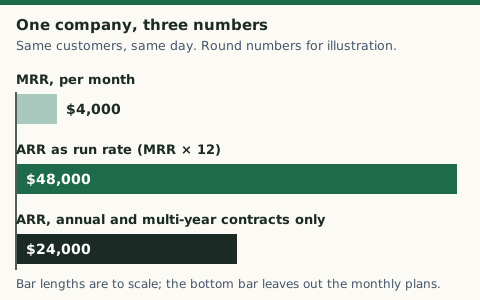
| Annualized run rate1 | $4,000 × 12 | $48,000 |
| Annual recurring revenue, strict1 | Annual plans $12,000 + the three-year contract $36,000 ÷ 3 | $24,000 |
The gap is not an error. The strict figure leaves out the monthly plans because the strict definition excludes anything under 12 months1. An investor shown “$48,000 ARR” and a lender shown “$24,000 ARR” for the same company (the two results of the Orchard example above) are both seeing true numbers, which is why the definition has to travel with the figure1.
When to use ARR vs MRR
MRR is especially valuable when the business is still finding product-market fit and growing quickly7. It reflects the impact of pricing changes and experiments almost immediately7. ARR becomes more useful as the business matures and decisions stretch beyond the next few months7. Companies use both, because MRR can show churn or a slowdown before it materially affects annual performance, and ARR shows whether the issue is isolated7.
| Situation | Better lens |
|---|---|
| Monthly billing, fast experiments | MRR8, 7 |
| Annual or multi-year contracts | ARR8 |
| Contracts under a year in the mix | MRR8 |
| Annual budgets, hiring plans and multi-year targets | ARR7 |
| Talking to investors, boards and external audiences | ARR, which gives a shared language7 |
Mercury observes that ARR vs MRR debates typically fade once ARR becomes the primary benchmark9. Whatever the choice, the rule that matters is consistency: define each metric once, write it down and apply the same formula across dashboards, updates and board materials9.
ARR vs revenue: where ASC 606 comes in
Revenue is defined by an accounting standard. Under ASC 606 the core principle is that an entity recognizes revenue to depict the transfer of promised goods or services in an amount that reflects the consideration it expects to be entitled to5. The last of its five steps is to recognize revenue when, or as, the entity satisfies a performance obligation5. A service delivered over time is recognized over time when the customer simultaneously receives and consumes the benefits as the entity performs5.
ARR sits outside that framework. At Datadog, ARR and MRR do not represent revenue under GAAP on a monthly or annualized basis, because they are operating metrics affected by contract start and end dates and renewal rates3, 5. Progress reaches the same point in different words: ARR is not defined in GAAP and is not derived from a GAAP measure, and it generally aligns to billings, while GAAP revenue aligns to the transfer of control of each performance obligation4, 5. ASC 606 has its own vocabulary for the pieces: a contract is an agreement that creates enforceable rights and obligations5, and the transaction price is the consideration the entity expects to be entitled to5.
Maxio’s practical reading: the annual recurring revenue ascribed to a contract element is in most situations roughly equal to the GAAP revenue for that element8, 5. It is still an imprecise financial expression that should never be confused with reportable GAAP revenue8, 5. ARR also does not account for revenue recognition8, 5. A one-time contract, such as a $50,000 project, counts as revenue but not as ARR9. A company that wants a clean vocabulary uses “GAAP revenue” for the income statement and “ARR” or “MRR” for subscription analytics8, 5.
How public companies define ARR
Two large filers make the point. They use the same acronym and different recipes.
| Datadog (fiscal 2025) | Progress Software (fiscal 2025) | |
|---|---|---|
| Definition | Annual run-rate revenue of subscription agreements from all customers at a point in time3 | Annualized revenue of all active and contractually binding term-based contracts at a point in time4 |
| Method | MRR × 123 | Contract value ÷ months in term × 124 |
| What goes in | Committed contractual amounts and additional usage, among other monthly revenue3 | Maintenance, software upgrade rights, public cloud, on-premises subscriptions and managed services4 |
| Currency | Not part of the definition | Constant currency, at current-year budgeted exchange rates4 |
| Latest figure | About 4,310 customers with ARR of $100,000 or more, 90% of ARR, at December 31, 20253 | $852.0 million at November 30, 2025, up 2% from $837.0 million4 |
For Progress, ARR has no standardized meaning, so it is unlikely to be comparable to similarly titled measures at other companies4. ARR is also not a forecast, because active contracts may or may not be extended or renewed4.
The SEC’s guidance on key performance indicators asks public companies for a clear definition of the metric and how it is calculated6. It also asks for the reasons the metric is useful to investors6. If the method changes, the company considers whether to recast prior metrics so the current disclosure sits in context6. A private company reporting to its board can borrow the same discipline.
Related terms: ACV, CARR and CMRR
ACV, ARR, MRR and CARR are connected but are not synonyms9.
| Term | What it measures |
|---|---|
| ACV (annual contract value) | Annual revenue per customer: total annualized contract value ÷ number of customers9 |
| CARR (committed annual recurring revenue) | Contracted recurring revenue that may not be live yet9 |
| CMRR (contracted monthly recurring revenue) | The contracted MRR from the booking date through the subscription end date8 |
Mercury’s ACV example: 10 customers each paying $20,000 a year give ARR = 10 x $20,000 = $200,000 and ACV = $200,000 ÷ 10 = $20,0009. Its CARR example: a contract signed in June that starts billing in September is committed and legally contracted, but not yet contributing to active ARR9. CARR is easy to misuse when founders inflate it with loose or potential commitments9. Few billing platforms track ARR at all, and most favor MRR8.
Common mistakes
- Counting one-time fees. Folding one-time fees or services revenue into ARR overstates predictable, recurring revenue1.
- Recording an annual contract at full value. It should be spread across the months it covers2.
- Mixing recipes. Two ARR figures built differently are not comparable, as Progress warns of its own metric4.
- Treating ARR as a forecast. Contracts in the figure may or may not renew4.
- Annualizing short contracts. The result can exceed the contract’s value at period end4.
- Confusing ARR with revenue. ARR is an operating metric and the income statement follows ASC 6063, 5.
Reporting ARR in a board package
A board package needs three lines next to the number: the definition, what is excluded and whether the recipe changed since the last report6. When ARR is MRR × 12, say so3. When it annualizes each contract’s value, say that4. Show the bridge from opening to closing with the six MRR movements, and compute the ratio that relies on it, net revenue retention, on the same recipe. The funding-side use of the same number is covered in how venture rounds work.
Common questions
RelatedNet revenue retention: formula, example, benchmarksHow venture rounds work: seed to exit, step by stepSaaS churn rate: formula, examples and benchmarks
Sources
- ARR: Annualized Run Rate vs Annual Recurring Revenue · ChartMogul (SaaS metrics library, updated September 8, 2026) · chartmogul.com · checked October 21, 2026
- Monthly Recurring Revenue (MRR) · ChartMogul (SaaS metrics library, updated September 8, 2026) · chartmogul.com · checked October 21, 2026
- Datadog, Inc. Form 10-K for the fiscal year ended December 31, 2025 · Datadog, Inc. (SEC filing) · sec.gov · checked October 21, 2026
- Progress Software Corporation Form 10-K for the fiscal year ended November 30, 2025 · Progress Software Corporation (SEC filing) · sec.gov · checked October 21, 2026
- Accounting Standards Update 2014-09, Revenue from Contracts with Customers (Topic 606) · Financial Accounting Standards Board · storage.fasb.org · checked October 21, 2026
- Commission Guidance on Management's Discussion and Analysis (Release 33-10751): key performance indicators and metrics · U.S. Securities and Exchange Commission · sec.gov · checked October 21, 2026
- How to use monthly recurring revenue (MRR) and annual recurring revenue (ARR) to guide growth · Stripe (last updated January 21, 2026) · stripe.com · checked October 21, 2026
- Annual Recurring Revenue (ARR): Growth Metrics for SaaS · Maxio · maxio.com · checked October 21, 2026
- ACV vs. ARR vs. MRR vs. CARR: Key revenue metrics · Mercury · mercury.com · checked October 21, 2026
Published . Rules and rates change: each source shows the day it was read. Education only, not advice. How we check facts · Report an error.