On this page
- What SaaS revenue recognition means
- The importance of accounting standards: why this one exists
- The five steps
- Revenue recognition for an annual plan: one prepayment, twelve months
- Deferred revenue, billings and remaining performance obligations
- Variable consideration: usage, overages and credits
- Plan upgrades and downgrades: contract modifications
- Cancellations and refunds
- Setup fees, add-ons and professional services
- Sales commissions and other contract costs
- Multi-geo and FX challenges: global billing and currency
- Impact: what can go wrong, and why metrics depend on it
- The 3-3-2-2-2 rule and where it fits
- Limits of this page
A software company can invoice a full year of service in January and report only one-twelfth of it as revenue that month, and still be following every rule. The reason is that the accounting standard asks a different question from the bank account: not “has the money arrived?” but “has the customer received what it paid for?” That gap between cash, invoices and revenue is where most SaaS finance confusion starts, and where most restatements start too.
This page walks through how that question is answered for subscription software. It covers the five-step model, the records that sit between a signed order and recognized revenue, and the situations that make SaaS accounting harder than selling a box: upgrades, refunds, usage fees, commissions and foreign currency. It sits in the metrics section because every metric on it, from ARR vs MRR to net revenue retention, is a different cut of the same revenue stream. Dollar figures in the worked examples are made up; the rules and the company figures come from the standard-setters, the SEC and three public filings.
What SaaS revenue recognition means
Revenue recognition decides when, and how much, revenue goes on the income statement. The core rule fits in one sentence: a reporting organization recognizes revenue when it satisfies a performance obligation by transferring a promised service to a customer, which is when the customer obtains control of that service1. A performance obligation is a promise to provide a distinct good or service, or a series of them4.
For software delivered over the internet, the customer never takes possession of anything. It gets access, week after week. That is why the same two rules recur in every subscription company’s annual report: access that is committed for a term is recognized ratably over that term, and usage is recognized as it happens2, 3, 4. The standard has a name for the test that produces this result: revenue is recognized over time when the customer simultaneously receives and consumes the benefits as the entity performs5.
Four words get mixed up in this area, and a clean vocabulary prevents most mistakes. Each is a different record of the same contract.
| Term | What it records | When it changes |
|---|---|---|
| Booking | The value of a signed contract, a forward-looking commitment8 | When the customer signs |
| Billing | The invoice amounts billed to customers8 | When the invoice is issued |
| Cash | Money actually received | When the customer pays |
| Revenue | The part of the contract for which the company has performed1 | As the service is delivered |
Two balance-sheet accounts sit in the gap. Deferred revenue, which Salesforce calls unearned revenue, represents amounts that have been invoiced in advance of revenue recognition3. HubSpot defines the same account as amounts billed for which revenue has not yet been recognized4. The opposite case also exists: unbilled revenue, which is recognized but not yet billable under the contract’s billing schedule8. Datadog reports approximately $127.0 million of unbilled accounts receivable at December 31, 2025, against $77.0 million a year earlier2.
The importance of accounting standards: why this one exists
Two reasons make a common rulebook worth the effort, and both are visible in the primary record. The first is comparability. FASB’s summary describes the pre-2018 position bluntly: U.S. generally accepted accounting principles (GAAP) had complex, detailed and disparate revenue requirements for specific transactions and industries, software among them1. The new guidance was written to replace numerous industry-specific requirements with one model1. The International Accounting Standards Board (IASB) issued the matching standard, IFRS 15, effective for annual periods beginning on or after January 1, 20186.
The second reason is that revenue is the number most often abused. The SEC’s 1999 staff bulletin on revenue cites a COSO study of 1987 to 1997 which found that over half of the financial reporting frauds it examined involved overstating revenue9. FASB’s summary puts the stakes from the reader’s side: revenue is one of the most important measures investors use to judge a company’s performance and prospects1.
A 2022 SEC order shows how that plays out in software. Synchronoss Technologies announced in July 2018 a restatement of its 2013 to 2016 financial statements covering approximately $190 million in cumulative revenues10. Part of the restatement involved transactions in which the company sold software licenses together with multi-year supporting services and recognized the license revenue immediately instead of ratably over the arrangement10. The order records that, under GAAP at the time, companies had to take into account all material terms of an arrangement, including side letters, when recognizing revenue10. It also records that the company lacked a fair-value measure for the hosting service it often provided, which forced the whole arrangement to be recognized over time10. The individual in that order was involved in three transactions that produced approximately $10 million of improperly recognized revenue10.
The five steps
FASB’s summary lists five steps, and IFRS 15 lists the identical five1, 6. Datadog, Salesforce and HubSpot each reproduce them as the framework in their annual reports2, 3, 4. The table shows each step as a question, followed by the SaaS-specific answer.
| Step | The question | The usual SaaS answer |
|---|---|---|
| 1. Identify the contract | Is there an enforceable agreement? | An order form or terms of service accepted by both sides1 |
| 2. Identify the performance obligations | What distinct promises does it hold? | Platform access, support, implementation and training, often separate3, 4 |
| 3. Determine the transaction price | What will the company be entitled to? | Fixed fees plus an estimate of variable fees, net of sales tax2, 4 |
| 4. Allocate the price | How much belongs to each promise? | In proportion to standalone selling prices1 |
| 5. Recognize revenue | When is each promise satisfied? | Over the term for access; as delivered for services2, 4 |
Step 1: Identify the contract
A contract is an agreement between two or more parties that creates enforceable rights and obligations1. The standard applies only to a contract that meets set criteria, among them that it is probable the company will collect the consideration it is entitled to1. In some cases separate contracts should be combined and accounted for as one1.
Step 2: Identify the performance obligations
A good or service is distinct if the customer can benefit from it on its own or with other readily available resources, and the promise to transfer it is separately identifiable from other promises in the contract1. If it is distinct, it is accounted for separately1. This single test decides whether an implementation project is its own line of revenue or part of the subscription.
The three filings reach different answers on purpose. HubSpot concluded that its subscriptions are distinct because once a customer has access, the product is fully functional and needs no additional development or customization4. Salesforce concluded that its professional services are distinct, after weighing four factors: whether other vendors offer the services, their nature, when the services contract was signed relative to the subscription start, and whether the service depends on the customer’s satisfaction with the work3. Datadog identified each of its monitoring services as a separate performance obligation2.
Step 3: Determine the transaction price
The transaction price is the amount of consideration the company expects to be entitled to in exchange for transferring promised services, excluding amounts collected on behalf of third parties1. HubSpot’s wording specifically excludes sales taxes collected for government agencies4. Datadog likewise excludes sales and other indirect taxes from subscription revenue2.
The price can be fixed or variable, and in SaaS it is often both. Datadog’s transaction price is the fixed price for the contracted level of service plus variable consideration for additional optional purchases2. The standard also adjusts the price for the time value of money when a contract includes a significant financing component1. A practical expedient lets a company skip that adjustment when the gap between delivery and payment will be one year or less5, and Datadog applies the expedient to contracts of one year or less2. Annual prepayment therefore does not normally require an interest calculation.
Step 4: Allocate the price to the obligations
A reporting organization typically allocates the transaction price to each performance obligation in proportion to the relative standalone selling price of each distinct promise1. If a standalone selling price is not observable, the organization estimates it1. Salesforce defines the standalone selling price (SSP) as the price at which it would sell a promised product or service separately to a customer3, and it weighs discounting practices, transaction size, customer demographics, geography and price lists when it has to judge one3.
Step 5: Recognize revenue when each obligation is satisfied
A performance obligation may be satisfied at a point in time, typically for goods, or over time, typically for services1. For an obligation satisfied over time the company selects a measure of progress6. Datadog chose an output method, recognition over time, because it most faithfully represents when the customer simultaneously receives and consumes the value2.
In practice the pattern per contract element is consistent across the three filings:
| Element | Recognition pattern | Filing |
|---|---|---|
| Committed subscription access | Ratably over the term, from the date the platform is made available2, 4 | Datadog, HubSpot |
| Usage above the commitment, or pure usage plans | As the product is used2 | Datadog |
| Support and updates | As provided, generally ratably over the term3 | Salesforce |
| Onboarding, training, consulting | As the services are provided4 | HubSpot |
| Professional services | As rendered on time-and-materials; proportional performance on fixed price; ratably if sold as a subscription3 | Salesforce |
Revenue recognition for an annual plan: one prepayment, twelve months
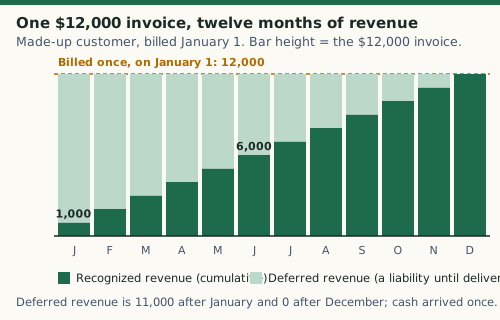
Take a made-up customer that signs a 12-month subscription on January 1 and pays the full $12,000 up front. Under the five steps there is one contract, one performance obligation (access for the term) and a fixed price of $12,000, so the allocation step is trivial. The obligation is satisfied evenly, so each month carries one-twelfth of the price (our arithmetic)2, 4.
Worked example (our arithmetic): $12,000 annual prepayment, recognized ratably (pattern from2 and4; every amount is made up)
| Month end | Billed this month | Revenue recognized | Deferred revenue at month end |
|---|---|---|---|
| January | $12,000 | $1,000 | $11,000 |
| February | $0 | $1,000 | $10,000 |
| March | $0 | $1,000 | $9,000 |
| June | $0 | $1,000 | $6,000 |
| September | $0 | $1,000 | $3,000 |
| December | $0 | $1,000 | $0 |
Twelve months at $1,000 add back to the $12,000 invoice. The monthly figure is $12,000 ÷ 12 = $1,000, and deferred revenue at any month end is $12,000 minus $1,000 for each month completed. Cash was collected once, in January, yet the income statement shows the revenue spread across the year. The chart at the top of the page draws the same schedule.
Billing the same made-up customer $1,000 each month (our arithmetic) produces the same revenue with no deferred balance, since each invoice covers the month just delivered. Chargebee’s guide makes the same point in vendor terms, that a company with high bookings but lower billings has a leading indicator of future cash flow problems8. For the metric side of this, see ARR vs MRR, which covers how a contract’s annual value is defined before it ever reaches revenue.
Deferred revenue, billings and remaining performance obligations
Public filings give a rare look at how the three records relate at scale. Salesforce’s roll-forward of unearned revenue for the year ended January 31, 2026 starts at $20,743 million, adds billings and other of $45,099 million, subtracts revenue recognized over time of $39,041 million and at a point in time of $2,484 million, and ends at $24,317 million3.
Worked example (our arithmetic): checking Salesforce’s roll-forward (inputs from3, in millions of dollars)
| Line | Amount |
|---|---|
| Opening unearned revenue | 20,743 |
| Add: billings and other | 45,099 |
| Less: revenue recognized over time | −39,041 |
| Less: revenue recognized at a point in time | −2,484 |
| Closing unearned revenue: 20,743 + 45,099 − 39,041 − 2,484 | 24,317 |
| Total revenue recognized from the balance: 39,041 + 2,484 | 41,525 |
| Growth in the balance: 24,317 − 20,743 | 3,574 |
Billings equal revenue plus the growth in deferred balances: 41,525 + 3,574 = 45,099 (our arithmetic), which matches the filing line. The identity is the reason analysts read billings as a leading indicator, and why a falling deferred balance with flat billings is a warning. Salesforce also cautions that its balance does not represent the total contract value of annual or multi-year noncancellable agreements3. Seasonality, renewals, invoice duration and invoice timing all influence the balance, not just demand3.
A third figure covers what has been signed but not yet invoiced or delivered. Remaining performance obligations (RPO) are the aggregate transaction price allocated to obligations not yet delivered, or partially undelivered, at the end of the period2. Datadog reports RPO of $3,461.2 million at December 31, 2025, against $2,273.1 million a year earlier, and expects to recognize substantially all of it over the next 24 months2. Salesforce reports total RPO of approximately $72.4 billion at January 31, 2026, up 14 percent year over year3. HubSpot reports approximately $1.6 billion of RPO on contracts with original performance obligations longer than one year, and expects to recognize approximately 89 % of it over the next 24 months4.
RPO is not a revenue forecast. It is a contracted backlog measured at the allocated transaction price, and its timing is uncertain for drawdown contracts, where future revenue can vary significantly from past revenue2. It also overlaps with deferred revenue, because RPO includes deferred revenue, multi-year contracts with future installment payments and certain unfulfilled orders2.
Variable consideration: usage, overages and credits
Add-ons and metered billing
Usage-based and overage pricing makes the transaction price uncertain. The standard’s answer has two parts. The company estimates the variable amount, and then includes it in the price only to the extent it is probable that a significant reversal of cumulative revenue will not occur when the uncertainty resolves1. In assessing that, an entity considers both the likelihood and the magnitude of a possible reversal5.
Salesforce applies it to overage fees, contingent fees and service level penalties, including an estimate in the total price only when a significant reversal is not probable3. HubSpot estimates variable consideration at contract inception and reassesses it at each reporting date4. In plain terms, upside that depends on future customer behavior waits until the behavior happens. DualEntry’s guide makes the same point for usage-based pricing: management must estimate variable consideration and constrain it, so that all potential upside is not booked today11.
For pure usage plans the answer is simpler. Datadog recognizes revenue as the product is used for usage-delivered contracts, for monthly subscriptions based on usage, and for usage in excess of a ratable subscription2. It bills committed annual or multi-year subscriptions in advance and bills usage above the commitment monthly in arrears2.
Worked example (our arithmetic): committed subscription plus overage (pattern from2; amounts made up)
| Line | Amount |
|---|---|
| Annual commitment, billed in advance | $10,000 |
| Ratable revenue each month: $10,000 ÷ 12 | $833.33 |
| Overage billed in arrears for May usage | $1,200 |
| Revenue for May: $833.33 + $1,200 | $2,033.33 |
| Revenue for June if there is no overage | $833.33 |
The overage is revenue in May, the month of use, even though the invoice goes out afterwards. The unbilled amount sits in unbilled receivables until the invoice is issued2. Chargebee’s guide describes the same treatment for metered overages in vendor terms: recognized in the month in which they accrue8.
Plan upgrades and downgrades: contract modifications
A contract modification is a change in the scope or price, or both, of a contract that is approved by the parties5. Approval can be in writing, by oral agreement or implied by customary business practices5. Until a modification is approved, the company keeps applying the guidance to the existing contract5. Upgrades, downgrades and mid-term add-ons all count as modifications, which is why DualEntry’s guide treats them as a single topic11. KPMG’s handbook notes that modifications continue to give rise to questions12.
The standard gives three outcomes, and the decision tree is short.
- A separate contract. If the scope grows because distinct services are added, and the price grows by an amount reflecting the standalone selling prices of those additions, the modification is accounted for as a separate contract5.
- A termination and a new contract. If it is not a separate contract, and the remaining services are distinct from those already delivered, the company accounts for it as if the old contract ended and a new one began5. The consideration allocated to what remains is the unrecognized part of the original price, including cash already received, plus the new consideration promised in the modification5.
- Part of the existing contract. If the remaining services are not distinct and form part of a single partly satisfied obligation, the effect is booked as a cumulative catch-up adjustment to revenue at the modification date5.
Many SaaS upgrades fit the second outcome. Access to the same platform after the change is a continuation of the same promise for the remaining term, and the contract is re-priced going forward.
Worked example (our arithmetic): a mid-year upgrade (rule from5; every amount is made up and the case is simplified)
| Line | Amount |
|---|---|
| Original contract: $12,000 for January to December, paid January 1 | $12,000 |
| Revenue recognized January to June: 6 × $1,000 | $6,000 |
| Unrecognized balance on July 1 | $6,000 |
| Upgrade on July 1: price for the last six months rises to $18,000 a year, so the six-month price is $9,000; extra billed | $3,000 |
| Consideration allocated to the remaining six months: $6,000 + $3,000 | $9,000 |
| Monthly revenue July to December: $9,000 ÷ 6 | $1,500 |
| Revenue for the year: $6,000 + 6 × $1,500 | $15,000 |
In the made-up example the upgrade lifts monthly revenue from $1,000 to $1,500, and the first six months are not restated. If the extra module had been sold as a distinct add-on at its standalone price, the first outcome would apply instead, and the add-on would simply be recognized as its own contract5. A downgrade works the same way in reverse, with the new, lower price spread over the remaining term and any refund treated as in the next section5.
Cancellations and refunds
What happens to the deferred balance when a customer leaves depends on the contract, not on the calendar. The SEC bulletin states that the price in arrangements the customer can cancel is neither fixed nor determinable until the cancellation privileges lapse9. If the cancellation rights expire ratably across the term, the price becomes determinable ratably as well9. The current standard handles refunds differently: when a company receives consideration and expects to refund some or all of it, it recognizes a refund liability5.
Most enterprise SaaS contracts remove the question. Salesforce reports that substantially all its subscription arrangements are noncancellable and contain no refund-type provisions3. Where a refund is possible, the accounting depends on whether the company will pay it.
Worked example (our arithmetic): $12,000 prepaid, canceled after three months (rules from5 and11; amounts made up)
| Case | Revenue to date | Deferred balance | Result |
|---|---|---|---|
| Canceled with no refund owed | $3,000, then the rest | $9,000 on cancellation | The $9,000 is recognized when the company has no remaining obligation, per11 |
| Canceled with $9,000 refund | $3,000 | $9,000 | The $9,000 moves to a refund liability and is paid out, so it never becomes revenue5 |
Under the first case, a DualEntry example reaches the same place: with no refund, the deferred balance for the undelivered service is recognized immediately11. The effect on metrics matters more than the accounting. A cancellation with no refund pulls the undelivered balance into one month’s revenue11, which makes that month look strong while the recurring base has dropped. Net revenue retention and churn are measured on the recurring base, not on recognized revenue, which is one reason the metrics page keeps them apart.
Setup fees, add-ons and professional services
An upfront fee can look like immediate revenue, and the test is whether it buys something the customer can use on its own. DualEntry’s guide frames it as a rule of thumb: a setup fee that delivers nothing on its own is spread across the subscription rather than booked on day one11. The SEC bulletin explains the principle behind it for nonrefundable fees received on entering an arrangement9. The bulletin’s example is a conveyed right or service that has no utility to the purchaser separate from the registrant’s performance of the other elements, so the fee follows those other elements9.
HubSpot recognizes onboarding, training and consulting as the services are provided, since it treats them as distinct obligations4. Salesforce recognizes time-and-materials work as rendered, fixed-price work on a proportional performance basis, and subscription-based services ratably3. Add-ons that extend access, such as extra seats, follow the modification rules above, and Datadog prices its additional services at or above the standalone selling price2, which fits the separate-contract test of a price reflecting standalone selling prices5.
Annual subscription with add-ons
Worked example (our arithmetic): bundle with a discount (allocation rule from1; SSPs and price are made up)
| Line | Subscription | Implementation | Total |
|---|---|---|---|
| Standalone selling price | $12,000 | $3,000 | $15,000 |
| Bundle price paid | $13,500 | ||
| Share of SSP | 12,000 ÷ 15,000 = 80% | 3,000 ÷ 15,000 = 20% | 100% |
| Allocated price | 80% × $13,500 = $10,800 | 20% × $13,500 = $2,700 | $13,500 |
| Pattern | $10,800 ÷ 12 = $900 a month | $2,700 as the work is done |
In the made-up bundle, the $1,500 discount is shared in proportion, not charged to one line. The rule has an exception: when a discount or variable amount relates entirely to one obligation, the standard specifies when it goes to that obligation alone1.
Sales commissions and other contract costs
The standard also covers the cost side. A reporting organization recognizes as an asset the incremental costs of obtaining a contract that it expects to recover, meaning costs it would not have incurred if the contract had not been obtained1. As a practical expedient, it may expense those costs when incurred if the amortization period is one year or less1.
SaaS filings show what that looks like. Salesforce capitalizes sales commissions on new and renewal contracts, with the associated payroll and benefit costs and success fees paid to partners3. It amortizes costs on new contracts over four years, on a straight-line basis, because that reflects the estimated average period of benefit including expected renewals3. HubSpot defers commissions and amortizes them over approximately two to four years4.
Worked example (our arithmetic): one commission, capitalized (method from1, four-year period from3; amounts made up)
| Line | Amount |
|---|---|
| Annual contract value | $12,000 |
| Commission paid at signing | $1,200 |
| Capitalized as an asset, amortized over four years | $1,200 ÷ 4 = $300 a year |
| Expense in each month | $300 ÷ 12 = $25 |
| Expense if the one-year expedient applied | $1,200 in the month incurred |
Multi-geo and FX challenges: global billing and currency
A SaaS company that bills in euros but reports in dollars adds a second layer on top of the five steps. Revenue timing still follows delivery of the service; the exchange rate affects the dollar amount and creates gains or losses between invoice and payment11. DualEntry gives the case of a U.S. company that bills €100,000 to a European customer and is paid in euros, with FX gains or losses reaching the profit and loss statement while revenue recognition stays tied to delivery11.
Worked example (our arithmetic): a euro invoice (made-up exchange rates; simplified to a single usage charge)
| Line | Amount |
|---|---|
| Usage charge billed on the last day of the month | €100,000 |
| Rate at billing: $1.10 per euro | €100,000 × 1.10 = $110,000 revenue and receivable |
| Rate when the customer pays: $1.05 per euro | €100,000 × 1.05 = $105,000 collected |
| Difference | $5,000 foreign exchange loss, outside revenue |
Revenue stays at $110,000 because the service was delivered when the receivable was set up. The $5,000 shortfall is a separate currency effect.
Impact: what can go wrong, and why metrics depend on it
The failures in this area fall into a few repeated shapes, and each shows up in the primary record. Revenue taken up front on a bundle that has a service running through the term is the Synchronoss pattern10. Terms hidden in side letters change the accounting even when the main contract looks clean10, 9. A refund that is expected but not recorded as a refund liability overstates revenue5.
The accounting also feeds the public metrics investors use. Annual recurring revenue, net revenue retention and churn appear nowhere in the five steps; they are management measures built from the same contracts that revenue recognition covers. A clean revenue schedule is therefore the base any metric definition has to reconcile to. The disclosures give outsiders a window into the schedule: FASB’s summary requires contract balances with opening and closing amounts of receivables, contract assets and contract liabilities1. That is the roll-forward Salesforce publishes3.
The 3-3-2-2-2 rule and where it fits
Searchers often connect revenue recognition with a “3 3 2 2 2” rule. It is a growth benchmark, not an accounting rule. The pattern is T2D3, “triple, triple, double, double, double”, a mantra a venture investor named to describe a SaaS company’s annualized revenue growth7. The path starts at $2 million in ARR, triples to $6 million, and then follows the doubling years7. It is not the only growth path to SaaS success7.
Worked example (our arithmetic): the T2D3 path from $2 million (pattern from7)
| Year | Growth | ARR |
|---|---|---|
| Start | $2 million | |
| 1 | ×3 | $6 million |
| 2 | ×3 | $18 million |
| 3 | ×2 | $36 million |
| 4 | ×2 | $72 million |
| 5 | ×2 | $144 million |
The link with this page is the definition of ARR itself. A growth benchmark is only as good as the recurring revenue figure underneath it, and that figure comes from contracts that must first be recognized correctly. ARR vs MRR covers how companies define the base, and net revenue retention covers expansion on that base.
Limits of this page
The examples above are simplified. Allocation, constraint and modification calls depend on each company’s own contracts, which is why Salesforce flags both the distinct-obligation call and the standalone selling price as judgments3. The full standard, not a summary page, governs a real set of financial statements. For the related operating pages, see net revenue retention, SaaS churn rate and the metrics hub.
Common questions
What is SaaS revenue recognition?
It is the accounting rule set that decides in which period subscription, usage and service fees count as revenue. The rule is to recognize revenue as each promised service is delivered, so a prepaid annual invoice is spread across the months of service instead of booked on the invoice date6, 3, 4.
How do SaaS companies recognize revenue under ASC 606?
They run the five steps on every contract. Committed subscription access is usually recognized ratably over the term, usage is recognized as it is used, and implementation work is recognized as it is performed2, 3, 4. Amounts billed ahead of delivery are held as deferred revenue4.
RelatedARR vs MRR: difference, formula and when to use eachNet revenue retention: formula, example, benchmarksSaaS churn rate: formula, examples and benchmarks
Sources
- FASB In Focus: Accounting Standards Update No. 2014-09, Revenue from Contracts with Customers (Topic 606), revised June 2020 · Financial Accounting Standards Board · storage.fasb.org · checked October 21, 2026
- Datadog, Inc. Form 10-K for fiscal year 2025 (filed 2026-02-18) · U.S. Securities and Exchange Commission (EDGAR), filing by Datadog · sec.gov · checked October 21, 2026
- Salesforce, Inc. Form 10-K for fiscal year ended January 31, 2026 (filed 2026-03-02) · U.S. Securities and Exchange Commission (EDGAR), filing by Salesforce · sec.gov · checked October 21, 2026
- HubSpot, Inc. Form 10-K for fiscal year 2025 (filed 2026-02-11) · U.S. Securities and Exchange Commission (EDGAR), filing by HubSpot · sec.gov · checked October 21, 2026
- Accounting Standards Update No. 2014-09, Revenue from Contracts with Customers (Topic 606), Section A (May 2014) · Financial Accounting Standards Board · storage.fasb.org · checked October 21, 2026
- IFRS 15 Revenue from Contracts with Customers · IFRS Foundation · ifrs.org · checked October 21, 2026
- Helping Entrepreneurs "Triple, Triple, Double, Double, Double" to a Billion-Dollar Company · Battery Ventures (Neeraj Agrawal) · battery.com · checked October 21, 2026
- Ultimate Guide to SaaS Revenue Recognition in 2026 · Chargebee · chargebee.com · checked October 21, 2026
- SEC Staff Accounting Bulletin No. 101, Revenue Recognition in Financial Statements (December 3, 1999) · U.S. Securities and Exchange Commission · sec.gov · checked October 21, 2026
- In the Matter of Marc Bandini, Release No. 95051 (June 7, 2022) · U.S. Securities and Exchange Commission · sec.gov · checked October 21, 2026
- SaaS Revenue Recognition: A Complete Guide · DualEntry · dualentry.com · checked October 21, 2026
- Handbook: Revenue for software and SaaS (December 2025 edition) · KPMG · kpmg.com · checked October 21, 2026
Published . Rules and rates change: each source shows the day it was read. Education only, not advice. How we check facts · Report an error.