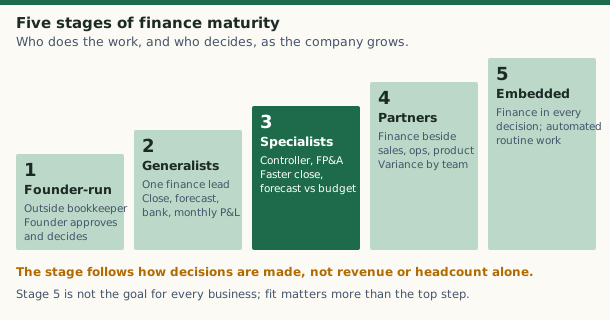
Most startups do not decide to build a finance function; they outgrow the one they have. This page lays out what the stages look like, what signals say the next one is due, what the upgrade costs, and where the audit and IPO horizon sits. It is part of the operations section, and it leans on the annual budget and burn rate and runway as the first documents a finance function produces.
What scaling finance means
One framework published for CFOs makes the point in a single line: if finance does not grow on purpose, it becomes the handbrake1. The author rejects the idea that stage is a revenue or headcount threshold, citing e-commerce brands above $100 million of revenue that outsource finance entirely1. The test is decisions, specifically where and how they are made1.
The five stages
The sections below follow that five-stage framework and add the primary-source facts that bear on each stage.
Stage 1: founder-run
Without a finance specialist, the founder outsources basic bookkeeping and tax to an outside firm or hands it to a general admin1. Every financial decision rests on the founder’s instinct and judgment rather than financial insight1. This is workable at small scale, and the U.S. Small Business Administration’s baseline still applies: keep proper bookkeeping and a basic knowledge of business finances8.
Stage 2: generalists
The company establishes a finance team, perhaps one person called Controller, Head of Finance or even CFO1. That person is a generalist who does a bit of everything to a reasonable standard: transaction processing, closing the books, building a forecast and dealing with the bank1. Monthly P&L reporting starts to form, and spend is approved through defined channels1. Finance leadership can arrive before a permanent CFO is justified: a startup can need CFO-level leadership before it has the complexity for a full-time one2.
Stage 3: specialists
The team starts to divide by discipline. A true controller, an FP&A specialist and perhaps a treasury or systems head appear1. The close becomes faster and more reliable, and forecasts move beyond static budgets1. Board reporting covers what this stage produces for directors.
Stage 4: partners
Finance steps out from behind the numbers and moves closer to the business, partnering with operations, sales and product to help them decide, not only to record1.
Stage 5: embedded
Finance becomes a way of thinking inside every decision, and routine work is automated1. The framework is explicit that this stage is not the goal for most businesses; the aim is to be fit for the business you are and the one you want to be1.
Signals that the next stage is due
Waiting is the usual mistake. Waiting too long to build the right finance infrastructure means expensive cleanup later6. The signals in one CFO-services guide are concrete: rapid hiring, institutional funding, increasing burn, sophisticated board requirements, multi-state expansion and preparation for another funding round2.
Budgets tend to fail because reality changes faster than the spreadsheet, not because the arithmetic is wrong6. A finance team that can evaluate the whole headcount plan against revenue expectations, available capital and runway is the practical answer2.
What a finance team costs
The cost question has two halves: what the company spends on general and administrative work, and what one finance hire costs.
SaaS Capital’s March 2026 survey of more than 1,000 private B2B software companies gives the first number. Across the sample the median G&A spend is 15% of ARR, up from 14% a year earlier3. For companies with $3 million to $5 million of ARR the median is also 15%3. Equity-backed companies spend 64% more on G&A than bootstrapped ones, which the survey attributes possibly to the need for a finance team that supports investor reporting, including regular board meetings and audits3.
Worked example (our arithmetic): the finance share of G&A at $4 million of ARR (G&A share from3, wage from4; the 20% on-cost is made up)
| Line | Amount |
|---|---|
| ARR | $4,000,000 |
| Median G&A at 15% of ARR | $600,000 |
| One financial manager at the national median wage | $166,570 |
| With a made-up 20% for benefits and payroll taxes: $166,570 × 1.20 | $199,884 |
| Share of the G&A budget: $199,884 ÷ $600,000 | 33.3% |
One such hire takes about a third of a median G&A budget, and G&A also has to cover legal, people operations and office costs. Salary is only part of the cost: benefits, payroll taxes, equity, equipment, software and ramp time all add to it6.
Controller, treasurer, cash manager: the roles
The U.S. Bureau of Labor Statistics defines financial managers as responsible for the financial health of an organization4. Its role list maps onto the stages above. Controllers direct the preparation of financial reports that summarize and forecast an organization’s financial position, and often oversee the accounting, audit and budget departments4. Treasurers oversee investments and plans to raise capital in support of growth4. Cash managers monitor the flow of money into and out of the organization4. Experienced financial managers may advance to chief financial officer, a role responsible for the accuracy of an organization’s financial reporting4.
How much does a CFO at a startup make?
The only public benchmark in this research is not startup-specific. The BLS median annual wage for financial managers was $166,570 in May 2025, with the lowest 10 percent earning under $94,310 and the highest 10 percent above $323,2704. Financial managers typically need a bachelor’s degree and five years or more of experience in another business or financial occupation4, and employment is projected to grow 10 percent from 2025 to 20354. Equity is a further cost of a senior hire6. No source in this research gives pay by company revenue, so a figure for a company of a given size is left out.
The audit and IPO horizon
For a company that expects to go public, the finance function eventually has to meet public-company requirements. The SEC lets an emerging growth company, one with annual gross revenues under $1.235 billion in its latest fiscal year, provide audited financial statements for two fiscal years instead of three5. It also lets such a company skip the auditor attestation of internal control over financial reporting under Sarbanes-Oxley Section 404(b)5. The status lasts for the first five fiscal years after an IPO unless a disqualifying event occurs5.
The exemptions change what an auditor must attest to, not whether the books have to be audit-ready.
The four practices of a CFO who scales growth
An Association for Financial Professionals roundtable on scaling described a tension between two archetypes: the “CFO-No,” who says no to everything to conserve capital, and the “CFO-Go,” who approves everything and gives up control7. The CFO’s job is to create the clarity, discipline and structure that let growth happen sustainably7. The four practices the group named are to lead with data, build trust, educate and engage, and create optionality7.
Growth is not a straight line7, and neither is the finance function that supports it.
Common questions
How much does a CFO at a startup make?
No source here splits startup CFOs out. The U.S. Bureau of Labor Statistics reports a median annual wage of $166,570 for financial managers in May 2025, with the lowest 10 percent under $94,310 and the highest 10 percent above $323,2704. Salary is only part of what a hire costs; benefits, payroll taxes and equity add to it6.
What are the four pillars of a successful CFO?
There is no standard list. An Association for Financial Professionals roundtable on growth named four practices: lead with data, build trust, educate and engage, and create optionality7. They describe a CFO who guides growth instead of approving or rejecting it7.
If this left you with a question, start with Startup annual budget: how to build one, with example or Burn rate and runway: formulas, example and benchmarks.
Sources
- When Finance Grows Up: Scaling the Finance Function I · CFO Secrets · cfosecrets.io · checked October 21, 2026
- How does a CFO help startups scale? · ERB Proximo · erb-us.com · checked October 21, 2026
- 2026 Spending Benchmarks for Private B2B SaaS Companies (June 10, 2026) · SaaS Capital · saas-capital.com · checked October 21, 2026
- Financial Managers, Occupational Outlook Handbook · U.S. Bureau of Labor Statistics · bls.gov · checked October 21, 2026
- Emerging Growth Companies · U.S. Securities and Exchange Commission · sec.gov · checked October 21, 2026
- Scaling Finance for Business Growth: CFO Strategy · StartupCFO.AI (LinkedIn) · linkedin.com · checked October 21, 2026
- Scaling for Growth: The CFO's Balancing Act · Association for Financial Professionals · financialprofessionals.org · checked October 21, 2026
- Manage your finances · U.S. Small Business Administration · sba.gov · checked October 21, 2026
Published . Rules and rates change: each source shows the day it was read. Education only, not advice. How we check facts · Report an error.