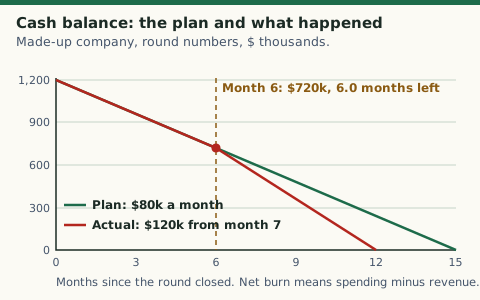
Marlow, a made-up software startup, closed its seed round six months ago with $1,200,000 in the bank. On the day it closed, the founders knew how long that would last: fifteen months, at the pace they planned to spend. Tonight the bank balance shows $720,000, and the number they need is not on the screen. It is the one that comes from dividing the balance by what the company now loses each month, and it has quietly dropped to six. Nothing dramatic happened in between. Two ordinary things did: time passed, and two engineers were hired.
This is the situation burn rate and runway exist to describe. They are the two numbers finance people reach for first when a company is spending money it raised rather than money it earned. This page defines both, runs Marlow’s six months through the arithmetic, and shows how investors, lenders and auditors read the result. It belongs to the operations side of startup finance and leans on the same revenue base as ARR vs MRR.
What burn rate and runway mean
Burn rate is the rate at which a startup spends its venture capital to cover overhead before positive cash flow comes from operations4. It is a common metric because it shows how long a company can keep operating before it becomes profitable or needs more financing4. Runway is the companion: the number of months a company can continue operating before it runs out of cash, assuming current spending levels stay the same7. The two go hand in hand: together they dictate how long a start-up has until its current operations can no longer be sustained6.
Gross burn and net burn
Burn rates can be gross or net4. Gross burn is the total money spent each month, while net burn is the money spent minus any revenue4. Net burn is the one that matters for runway: the formula for net burn is total monthly cash expenditures minus total monthly revenues4. Gross burn still earns its place on a dashboard, because it shows what the company would lose if revenue stopped.
One condition limits the whole idea. Once a startup earns more than it spends, burn rate is meaningless, and as a metric it only helps startups whose expenses still exceed revenue5.
The cash runway formula
The formula for cash runway is the amount of cash on hand divided by the burn rate6. Pilot writes it as total cash held divided by average burn rate, which gives the number of months before the money runs out5. The result assumes expenses and revenue stay constant and that no new funding arrives5.
| Measure | Formula |
|---|---|
| Gross burn | Total monthly cash expenditures4 |
| Net burn | Total monthly cash expenditures − total monthly revenues4 |
| Burn from cash balances | Cash balance in the prior month − cash balance in the current month5 |
| Runway | Cash on hand ÷ net burn rate, in months6, 4 |
| Average burn | Add the monthly burn rates and divide by the number of months included5 |
Using an average matters. Pilot recommends the average burn rate over a run of months instead of one month’s figure, because it gives the more accurate answer5.
Including investor funding
Burn measured from cash balances has a trap. Say a startup just closed a round: its burn rate might show as negative for that month, because it appears to be gaining money overall5. Founders who want burn regardless of ongoing funding should first subtract recent funding from total cash5. That version shows how close the company is to recouping expenses from revenue-generating activities alone, and it is the first step in knowing how long the business would last if fundraising stopped5.
Worked example (our arithmetic): the month the round closes at Marlow (method from5)
| Line | Amount |
|---|---|
| Cash at the end of the previous month | $180,000 |
| Round received during the month | $1,200,000 |
| Net spending in the month | $80,000 |
| Cash at the end of the month | $1,300,000 |
| Burn from the two balances | $180,000 − $1,300,000 = −$1,120,000 |
| Burn with the round taken out | $180,000 − ($1,300,000 − $1,200,000) = $80,000 |
The first figure makes it look as though Marlow gained over a million dollars. The second shows the $80,000 it lost, which is what happened operationally.
How to calculate runway
- Find cash and revenue. The easiest place to find the inputs is the cash flow statement5.
- Work out net burn for each recent month. Subtract each month's cash balance from the previous month's, and take out any funding that arrived5.
- Average the months. Add the monthly burn rates and divide by the number of months5.
- Divide. Today's cash over the average net burn is runway in months5, 6.
- Compare it with the plan. Runway needs to be read against how long it will take to secure more funding or earn enough revenue to offset expenses5.
Published examples keep the arithmetic short. Wall Street Prep’s start-up has $200,000 in cash, monthly cash sales of $50,000 and monthly cash expenses of $30,000, so the net burn rate is $20,000 per month and the implied runway is 10 months6. Corporate Finance Institute’s startup has $250,000 in the bank, spends $90,000 a month and brings in $20,000, so it will likely run out of cash in 3.6 months unless it raises capital soon7. Pilot’s example has $150,000 now and $200,000 a month earlier, so the startup has only 3 months of cash5.
Marlow, month 0 to month 6
Marlow’s plan at the close of the round is a rate of spending that the seed money can carry for a long time. Gross burn is $95,000 a month and revenue is $15,000, so net burn is $80,000 and runway is fifteen months.
Worked example (our arithmetic): Marlow’s runway at two dates (formula from6 and4)
| Month 0 | Month 6 | |
|---|---|---|
| Cash on hand | $1,200,000 | $720,000 |
| Gross burn per month | $95,000 | $150,000 |
| Revenue per month | $15,000 | $30,000 |
| Net burn per month | $80,000 | $120,000 |
| Runway | $1,200,000 ÷ $80,000 = 15.0 months | $720,000 ÷ $120,000 = 6.0 months |
| Runway had burn stayed at $80,000 | $720,000 ÷ $80,000 = 9.0 months |
Runway fell by nine months over a period of six, and the table shows where the other three went. Six months of spending took it from 15.0 to 9.0, which is simply the clock. The extra hiring took it from 9.0 to 6.0. Revenue doubled in the same window and still did not offset the new payroll.
The two lines in the chart are the whole case for tracking runway monthly. They are identical for six months and the gap opens only when burn changes, which is exactly when the old plan stops being a good guide.
How startups use burn rate
Burn rate tells a startup where the money goes, which parts of the business use cash too quickly, and where to cut so spending focuses on growth4. It informs fundraising: a startup with a shorter runway may face valuation pressure during a raise, because the risk of cash depletion is higher4. It also shapes planning. Founders must estimate projected runway to time when to begin raising interest from investors for the next round6.
What counts as a normal burn depends on the business. Startups in transportation, aviation and aerospace typically have high burn rates, because the work needs heavy spending on research and development, hardware and labor4. Software startups that only need a few developers can keep their burn rate low4. Funding model matters too: VC-backed startups often show high burn from prioritizing growth over profitability, while bootstrapped startups tend to be more cost-conscious4. Burn also moves with the stage. At seed, revenue is often negligible, so even modest spending can be a high burn relative to reserves, and at Series A the burn typically increases as the company invests in hiring, marketing, sales and product development4.
Stripe’s reproduction of the OpenView 2023 SaaS Benchmarks Report gives a sense of scale for software companies. Median monthly burn was $50,000 for companies under $1 million of ARR, $175,000 for $1 million to $5 million, $175,000 for $5 million to $20 million, $113,000 for $20 million to $50 million and $175,000 above $50 million4. Stripe’s page does not state the survey sample, so treat the figures as a rough shape, not a target.
How investors and lenders read it
Investors look at burn rate to work out how long a startup can keep going before it needs more money4. A high burn rate might be justifiable in the context of swift growth and market capture, but if growth metrics are also low it could signal a flawed business model4. Lenders read it too, and the 10-K of TriplePoint Venture Growth BDC, a venture lender, shows how. One of its criteria for a borrower is a balanced financial condition, typically with 12 months or more of operating cash runway based on projected cash burn, or a path to profitability over a three- to five-year period from the date of investment2. It also looks for upcoming milestones that its investment can help provide operating cash runway to reach2. In its monitoring, the key topics reviewed include the timing and status of the next equity financing round, cash balance and burn rate, financial and operational progress, and covenant adherence2.
That list is useful as a checklist. A founder who can state cash balance, burn rate, the next financing’s timing and progress against milestones is answering the questions a professional lender asks every quarter.
A word on publishing the number. If a public company reports a burn or runway figure as a key metric, the SEC’s guidance on key performance indicators asks for a clear definition of the metric and how it is calculated3. It also asks for a statement of why the metric is useful to investors, and whether to recast prior metrics when the method changes3. A private company reporting to a board can apply the same three tests.
How much runway is enough?
There is no universal answer, and each source frames it differently. In many cases companies aim for at least 6-12 months of runway, which gives the team time to hit key milestones, adjust course or raise new funding without last-minute pressure7. Corporate Finance Institute cites a 2024 survey of 110 venture capitalists, in which a majority (53.7%) advised portfolio companies to maintain 6-12 months of runway before their next raise, while 29.6% recommended more than 18 months7. The venture lender above looks for 12 months or more2.
Early-stage startups may get by with a shorter runway if they are close to launching or fundraising7. Pilot’s version is blunter: if a company has three months of runway but its product will not launch for another six months, it clearly does not have enough5. Whether runway is enough depends on how long it will take to secure more funding or earn enough revenue to offset expenses5.
The editors’ reading of the spread: 6-12 months is a floor for planning7, and the lender’s 12 months or more is a floor for being financeable2. Neither number accounts for how long a raise really takes, which is the reason to start the process while runway still exceeds it.
Default alive or default dead
Paul Graham’s 2015 essay puts the question differently. Assuming expenses stay constant and revenue grows as it has over recent months, does the company reach profitability on the money it has left8? If so, it is default alive; if not, default dead. He observed that half the founders he talked to did not know which they were8. The reason the answer matters is that the rest of the conversation depends on it8.
His warning is the fatal pinch: default dead, plus slow growth, plus not enough time to fix it8. A common route into it is to assume that raising more money will be easy, an assumption that is often false, and the more a company depends on it, the falser it becomes8. If revenue growth is steep, say over 5x a year, a company can start to count on investor interest even when unprofitable8. Fundraising should still be only a plan A, with a written plan B and the date when the company would switch to it8.
Worked example (our arithmetic): Marlow at month 6, with gross burn held at $150,000 and revenue growing from $30,000 a month (net burn $120,000 at flat revenue, from the table above)
| Monthly revenue growth | Cash runs out |
|---|---|
| 0%, revenue flat at $30,000 | End of month 6 |
| 5% | During month 7 |
| 10% | During month 7 |
| 15% | During month 8 |
Growth helps only a little because the runway is short: the revenue gap is $120,000 a month and a few months of compounding does not close it. Marlow is default dead on any growth rate in the table, and the only open questions are how fast to change burn and how soon to raise.
The going-concern test: one year
Auditors and boards apply a harder version of the same look-ahead. Under the going-concern update from FASB, management evaluates in each annual and interim reporting period whether conditions or events, taken together, raise substantial doubt about the company’s ability to continue as a going concern within one year after the financial statements are issued1. Substantial doubt exists when it is probable that the company will be unable to meet its obligations as they become due within that year1. The evaluation rests on conditions and events that are known and reasonably knowable at the issue date1.
Management’s plans count only partly. Their mitigating effect is considered only to the extent that it is probable that the plans will be effectively implemented, and probable that they will mitigate the conditions that raise substantial doubt1. If substantial doubt is not alleviated, the footnotes must say so1.
Read against Marlow, the test is a hard edge. At month 6 the company has 6.0 months of runway on current burn. The accounting question looks twelve months out from the date the statements are issued, so a runway well short of a year, with no raise probable enough to count, is the kind of condition management would have to weigh and possibly disclose. That is a simplification: the standard looks at obligations as they fall due, not at a runway ratio, and anyone preparing audited statements needs their accountants. The point for operators is that the one-year horizon is not an investor preference. It is how the financial statements are meant to be tested.
Should you reduce your burn rate?
Not automatically. Many founders are quick to assume they should reduce burn, but it depends on how the money is spent and what it does for the company; spending on top engineers, salespeople and marketers can be money well spent5. The cuts worth making are the ones that buy nothing, such as subscriptions to tools the team does not use5.
Where cuts or timing changes are needed, the published options are practical.
- Hire strategically. Prioritize roles that contribute directly to growth or revenue, delay nonessential hires and consider part-time or contract positions4. Paul Graham puts it more strongly: hiring too fast is by far the biggest killer of startups that raise money8.
- Review spending. Regularly review expenses and assess the value received4. Start with discretionary items that do not directly affect operations7.
- Raise revenue. Finding quicker paths to market and improving sales processes can balance out the burn rate and extend runway4.
- Speed up collections. This does not reduce burn, but it improves cash timing, which extends runway7.
- Forecast. Assess future scenarios to prepare for cash shortfalls4, and run sensitivity analysis on hires, fundraising delays and pricing changes7.
- Raise early. Secure capital before it is needed, to avoid raising under less favorable terms4.
Worked example (our arithmetic): Marlow’s options at month 6 (formula from6)
| Option | Net burn per month | Runway at $720,000 |
|---|---|---|
| Do nothing | $120,000 | 6.0 months |
| Pause the two hires, saving $30,000 a month | $90,000 | 8.0 months |
| Speed up collections | $120,000 | 6.0 months, with cash timing improved7 |
Pausing the hires buys two months. It does not turn Marlow default alive, which is why the realistic plan combines the pause with an early raise, started while the 8.0 months still leave room for the process. Hiring too fast also features in a common way startups die, as Paul Graham lays it out: moderately appealing product, decent early growth, an easy first round, a hiring spree that does not produce growth, then high expenses and slow growth that make the company unappealing to investors8.
What to track every month
Keep the habit small. Record cash, gross burn, revenue, net burn and runway in the same place each month, using the same definitions, and keep the average burn alongside the single month5. Add the date of the next financing and the milestone it is meant to fund, the pair a venture lender reviews every quarter2. The metrics that tie most closely to burn are covered elsewhere on this site: CAC payback period shows how long acquisition spend takes to come back, and SaaS churn rate shows how fast the revenue base leaks. How a priced round or a convertible instrument adds to cash is laid out in how venture rounds work.
If this left you with a question, start with CAC payback period: formula, example and benchmarks or SaaS churn rate: formula, examples and benchmarks.
Sources
- Accounting Standards Update 2014-15, Presentation of Financial Statements, Going Concern (Subtopic 205-40) · Financial Accounting Standards Board · storage.fasb.org · checked October 21, 2026
- TriplePoint Venture Growth BDC Corp. Form 10-K for the fiscal year ended December 31, 2025 · TriplePoint Venture Growth BDC Corp. (SEC filing) · sec.gov · checked October 21, 2026
- Commission Guidance on Management's Discussion and Analysis (Release 33-10751): key performance indicators and metrics · U.S. Securities and Exchange Commission · sec.gov · checked October 21, 2026
- What is burn rate? What startups need to know about this key metric · Stripe · stripe.com · checked October 21, 2026
- Burn rate calculation and startup runway calculator · Pilot · pilot.com · checked October 21, 2026
- Cash Runway | Formula + Calculator · Wall Street Prep · wallstreetprep.com · checked October 21, 2026
- Cash Runway Explained · Corporate Finance Institute · corporatefinanceinstitute.com · checked October 21, 2026
- Default Alive or Default Dead? (October 2015) · Paul Graham · paulgraham.com · checked October 21, 2026
Published . Rules and rates change: each source shows the day it was read. Education only, not advice. How we check facts · Report an error.