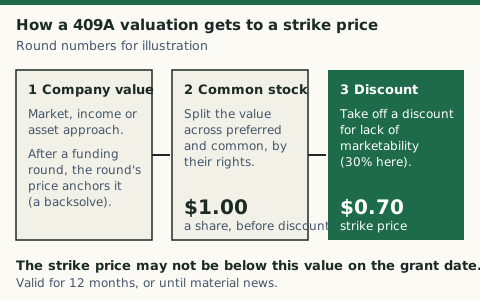
Kestrel, our made-up software company, has just closed a seed round and wants to hire its first engineer with an offer of stock options. The offer needs one number before it can be written: the price at which the engineer may buy shares. That number is not a negotiating position, and it is not a share of the last round’s price. It comes from a valuation that has a name, a rulebook and a shelf life. This page follows Kestrel through it. It belongs to the equity and finance team section, it describes United States federal rules, and it is education, not tax advice.
What a 409A valuation is and how it works
Public companies are valued by the price their stock trades at, but a private company needs a valuation to find the fair market value of its equity5. The 409A valuation does that job for the common stock, and it also fixes the strike price, which has to be at or above that value5. The name comes from section 409A of the Internal Revenue Code, which the American Jobs Creation Act of 2004 added, as IRS Notice 2005-1 records3. The statute’s own title is “Inclusion in gross income of deferred compensation under nonqualified deferred compensation plans”2.
The rule in plain words: an option to buy company stock is not deferred compensation if the exercise price can never be less than the stock’s fair market value on the day the option is granted, and the number of shares is fixed on that day1. The option must also be taxed under section 83, and it may carry no deferral feature beyond postponing income until exercise or disposition1. Pass those tests and the option stays outside 409A. Miss the first one and an option with an exercise price below fair market value generally counts as deferred compensation1, 3.
The test targets nonqualified options: an incentive stock option under section 422 and an option under an employee stock purchase plan under section 423 are carved out1. The valuation exists to establish safe harbor status with the IRS6.
For Kestrel the question is therefore narrow. What is a share of its common stock worth on the day the engineer’s option is granted, and can the company prove it?
Why the strike price cannot be below fair market value
The reason is what happens to the holder. If a plan fails 409A, all compensation deferred under it for the year and all earlier years is includible in gross income for that year, to the extent it is not subject to a substantial risk of forfeiture and not previously included2. The tax for that year also goes up by an amount equal to 20 percent of the compensation included in gross income2. Interest follows, at the underpayment rate plus 1 percentage point on the underpayments that would have occurred had the amount been included when first deferred2.
Run the numbers on a small grant. Say 10,000 options vest in a year, the grant set the exercise price at $0.90, and fair market value at the end of that year is $4.00. Those inputs are made up. The table applies the statute’s two amounts to them and ignores the interest, which depends on dates and rates.
Worked example (our arithmetic): a discounted option that fails the test (inclusion and 20 percent rule from2)
| Line | Amount |
|---|---|
| Compensation included in gross income2 | 10,000 × ($4.00 − $0.90) = $31,000 |
| Additional 20 percent2 | $31,000 × 0.20 = $6,200 |
That is the whole case for a defensible valuation: the price protects the person who holds the option.
How is valuation calculated for a startup? Three steps
A startup’s 409A valuation is calculated in three steps4. The first step finds how much the company is worth, the enterprise value4. The second step allocates that value across the equity classes to reach the fair market value of the common stock4. The last step applies a discount, because the stock is not publicly traded4.
The Treasury rule does not name these steps. For stock not readily tradable on a securities market, fair market value is the value found by the reasonable application of a reasonable valuation method1. Whether a method is reasonable depends on the facts and circumstances as of the valuation date1. The factors include the value of the company’s tangible and intangible assets, the present value of its anticipated cash flows and the market value of similar corporations1. Recent arm’s length transactions in the stock, control premiums and discounts for lack of marketability also count1. There is no universal formula for the value of an illiquid, non-controlling interest in a closely held company5.
A company may use a different valuation method for each separate action1. It must use a single method for each action and cannot alter it retroactively once used1.
Two limits stop a method from being reasonable. It must take into account all available information material to the value of the company1. And a value calculated earlier is not reasonable later if it misses information that came after, such as the resolution of material litigation or the issuance of a patent1.
Step one: the value of the company
Valuation work uses three main approaches, and they can be combined: market, income and asset-based4. Early-stage companies tend to lean on a market approach, and more mature ones on an income approach4.
| Approach | What it does | Where it fits |
|---|---|---|
| Market: guideline public companies | Compares the company with listed peers and applies their multiples5 | Unprofitable early-stage companies, where long-range results are hard to predict4 |
| Market: guideline transactions | Applies multiples from actual deals in the same or related industries5 | Where comparable transactions exist5 |
| Market: backsolve | Solves for equity value from the price of a recent financing, using an option pricing model5 | Right after a fundraise, when the round’s valuation is used4 |
| Income: discounted cash flow | Discounts future profit streams to today’s dollars4 | Companies with scale, predictable results and a line of sight to profit4 |
| Asset: replacement cost | Values the assets and liabilities4 | Rarely used for venture-backed companies4 |
In the market approach, profitable companies are usually valued on an EBITDA multiple, and early-stage companies with negative EBITDA on revenue multiples4. Comparable sets of five or more listed companies are typical inputs4. The asset approach also gets expensive, because intangible assets such as IP are costly to appraise4.
The backsolve is what Kestrel will meet first. After a fundraise, determining the enterprise value is straightforward, because the value of that round is used4. A backsolve is the way a founder will almost always first meet a 409A valuation4. It rests on the equity value implied by the sale price of shares in a recent financing, run through an option pricing model that considers the capital structure and the rights of the preferred and common stockholders5.
A practical note. The forecast the valuer receives should be the one the board sees, because that forecast is one of the first places a reviewer looks to test the assumptions4.
Step two: from company value to common stock value
Only a company with nothing but common stock gets a one-line answer: the enterprise value divided by the fully diluted shares outstanding, and that case is extremely rare for a venture-backed company4. Kestrel has preferred stock held by its seed investors, so the value must be split.
| Allocation method | How it works | When it is used |
|---|---|---|
| Option-pricing model (OPM) | Treats each class of stock as a call option with its own exercise price4 | Companies too early to identify exit scenarios and their timing4 |
| Probability-weighted expected return (PWERM) | Models an IPO, an acquisition, dissolution or continued operation and assigns each a probability4 | Companies that can estimate exit scenarios and timing with reasonable confidence4 |
| Hybrid | Weights scenarios, and uses OPM inside one or more of them4 | A near-term exit is likely, but the fallback is uncertain4 |
| Current value method | Takes today’s equity value and assumes an immediate sale or dissolution4 | Very rarely used for a venture-backed company4 |
OPM is the most frequently used of the four in venture-backed work, and Black-Scholes is the most commonly used option-pricing model inside it4. A handful of assumptions drive its output: the enterprise value, volatility and the expected time to exit4. The longer the time to exit, the more valuable the option, because more time gives it a better chance of finishing in the money4.
The allocation takes into account each class’s economic rights, meaning liquidation preference, conversion, dividends and participation4. The preference stack shows up in the result. A company acquired for less than or equal to its liquidation preferences leaves $0 for the common stockholders in the OPM4. Common stock values tend to be higher under PWERM, because in an IPO the preferred stock converts to common and the liquidation preferences disappear4.
Why are 409A valuations so low?
Because a common share is a different security from the preferred share the investors bought. The preferred stands in front of the common in a sale, and the allocation step prices that gap4. Valuations that sound too low are often reasonable because of the economic rights of the preference stack4. Common stock is also illiquid, which the last step prices separately4.
Step three: the discount for lack of marketability
The last step applies a discount for lack of marketability, DLOM, to the common stock value from step two4. The allocation models assume stock that can be sold immediately, and employees cannot sell theirs4. The main variable is the time to a liquidity event4. Most DLOM studies reach a discount of 25%-35% for a two-year holding period4. The discount shrinks as the company scales and gets more likely to succeed4. After a backsolve it tends to be lower than those ranges, because the valuation benchmarks to a preferred instrument that already carries some lack of marketability4.
Suppose step two leaves the common stock at $1.00 a share and the valuer picks a 30% discount, inside the published range. Both numbers are assumed.
Worked example (our arithmetic): the discount step only (DLOM range from4)
| Line | Amount |
|---|---|
| Fair market value per share after the discount4 | $1.00 × (1 − 0.30) = $0.70 |
| Strike price at or above that value1 | $0.70 or more |
Real work is messier, because step two never gives a round number. The point is the order: allocation first, discount last.
Why hire a 409A valuation firm
A company can try to value its own stock, but the easiest and most common way to get the safe harbor is a qualified, independent valuation provider4. The Treasury rule gives that route a presumption. The appraisal must be independent and meet the requirements of section 401(a)(28)(C)1. If it is made no more than 12 months before the transaction it supports, the value is presumed reasonable1. The Commissioner can rebut the presumption only by showing that the method, or its application, was grossly unreasonable1.
A second route exists for young companies. A valuation made reasonably and in good faith, evidenced by a written report that takes the regulatory factors into account, also qualifies for illiquid stock of a start-up1. A start-up here means a company with no material trade or business conducted for 10 years or more and no class of equity securities traded on an established securities market1. The route is closed when the company can reasonably expect a change in control within 90 days, or a public offering within 180 days, after the action the valuation supports1.
The valuer must also be qualified. A valuation is not made in good faith unless the person doing it is one the company reasonably determines is qualified1. Significant experience generally means at least five years in business valuation or appraisal, financial accounting, investment banking, private equity, secured lending or comparable work1.
The provider does the heavy lifting, matches the analysis to the company’s narrative, helps with messaging to employees and builds a coherent valuation history5. The conclusion is a recommended fair market value per share of common stock, used to support option strike prices5. Hiring a firm still does not make the result bulletproof. An expert does not automatically guarantee the safe harbor4. How to choose: look for a provider with experience valuing companies like yours4.
What you give the valuer
The inputs are ordinary documents and estimates:
- The current charter, also known as the certificate of incorporation4.
- The most recent cap table4.
- The board presentation and recent pitch deck, if a fundraise just closed4.
- Company historicals plus a three-year projection of profit and loss, cash and debt4.
- An estimate of the options the company expects to issue over the next 12 months4.
- A list of five or more public comparables, which carries into later valuations4.
- Timing expectations for liquidity events such as an IPO or acquisition4.
- Significant events since the last valuation4.
How long it takes
With every input in hand, a final draft for board approval takes about two weeks4. A typical timeline has data collection, modeling, draft schedules and management review in the first two weeks, then board approval and option grants in the third week4. The auditor should join the kick-off call before a new valuation starts4. An auditor review can add time: if the valuation is complex, or an IPO is expected within two years, the auditor may ask a valuation specialist to review a draft, which adds a minimum of one week4. Once annual revenue reaches around $10M, investors expect audited financials, and the auditor will review the valuation because it drives stock compensation expense4. If the auditor finds a flaw, the company must revisit that valuation and the prior ones4.
How often to do a 409A valuation
The rule gives a hard stop for old numbers. A previously calculated value is not reasonable later if it was calculated for a date more than 12 months before the date it is used1. It is also stale sooner if material new information has arrived1. Practitioners summarize it as at least once every 12 months, or when a material event occurs, whichever comes first4.
Material events fall into a few groups.
| Event | Why it calls for a fresh look |
|---|---|
| New equity financing | Priced rounds, SAFE or note conversion dynamics and significant secondary activity all reset the evidence5 |
| Acquisition offer or IPO talk | An acquisition offer, or M&A and IPO discussions with a credible indication of interest4, 5 |
| Secondary sale of common stock | Certain secondary sales are material events4 |
| Outlook or performance change | Significant changes, good or bad, in the outlook, such as rapid growth, a major customer win or loss, or a margin shift4, 5 |
| Product or market milestone | A launch, regulatory clearance or major partnership5 |
| Balance sheet change | A large cash infusion, new debt or a liquidity event5 |
| Corporate action | Recapitalizations, amendments to preferred terms, or option plan changes that affect value5 |
A company credibly approaching an IPO values far more often, for example quarterly or even monthly4.
A term sheet resets the clock
The sharpest event is a signed term sheet for a priced round. Most valuation firms then treat the current 409A price as unusable for option grants, because they view the term sheet as a material event that implies a change in the company’s valuation7. The practical advice is to clear any promised-option backlog before signing7. Promised options are options, restricted stock awards or purchases, RSUs, SARs, warrants and similar securities that were promised but not yet granted7. A company that handles them this way should have none left to worry about7.
Kestrel’s own timeline shows how it plays out. If the latest valuation set fair market value at $0.05, new hires get a strike price of $0.056. Suppose its valuation was done on January 1 and it then closes a pre-seed round at $8 million pre-money in July: the January number is out of date for the new hires, and a new valuation is needed6. In NASPP’s example the fair market value rose from $0.05 to $0.25 over that round6.
How much a 409A valuation can cost
For many early-stage private companies, third-party valuations often fall in the low thousands of dollars5. Costs can rise to multiples of that for later-stage companies, or where complexity and frequency go up, for example where the 12-month safe harbor no longer applies because an IPO is planned5.
What moves the price5:
- Stage. Later-stage businesses with more stakeholders require more work.
- Capital structure. Multiple preferred classes, participating preferred, warrants, SAFEs, convertible notes, secondary transactions and complex option plans increase effort.
- Rounds and terms. More rounds and bespoke terms mean deeper modeling.
- Rush requests. Expedited turnarounds frequently carry extra fees.
- Audit support. Workpapers beyond the report widen the scope.
The cost is small next to what it protects, which is the employee’s tax position under the rule above.
Myths about the strike price
Safe harbor is proof that the company calculated a reasonable fair market value of its common stock5. A valuation is not an exercise in maximizing the minimum, where the goal is for the common stock to appreciate as little as possible from the prior value4. Valuations are also connected to each other, so the current one should not be read in a vacuum4.
Myth: common stock is worth 20% of the last round’s price
A rule of thumb used to be common: set the common value at 10-20% of the latest preferred round4. Only in rare instances is that legitimately right, even for seed-stage companies4. Without running a real valuation no one can know the common stock’s fair market value from memory4. For Kestrel, the seed round’s price is an input to the backsolve, not a multiplier.
Myth: you can show the valuer a lower forecast
The forecast given to the valuer must be the one the board uses, and a mismatch causes problems with auditors and can put the safe harbor at risk4.
Myth: the lowest strike price wins
Companies want a low common value because it makes options look more lucrative4. If a high value starts to hurt recruiting, a company can consider a stock split to bring the strike price back down4. The gain from squeezing the price is small. In a six-year example with 100,000 options and a $50 share price at exit, a $0.35 strike price yields $4,965,000 before taxes4. A $2.00 strike price yields $4,800,0004. The strike prices differ by 471%4. The outcome differs by 3%4.
Myth: the strike price must equal the valuation exactly
The strike price cannot be lower than the valuation’s fair market value, but it can be higher4. Setting it higher is useful when the company’s enterprise value has declined since the last valuation4. The company can then keep the strike price flat at the earlier valuation to protect morale4.
Changing an option after the grant
Repricing is its own trap. A modification of the terms of a stock right is considered the grant of a new stock right1. A modification includes any change that may give the holder a direct or indirect reduction in the exercise price1.
When a low value backfires
A too-aggressive valuation has a shelf life. When an audit or a financing forces a clean valuation, the fair market value steps up sharply4. Employees hired days apart then hold very different strike prices, and resentment can build in a world of “haves” and “have-nots”4. In an acquisition, the buyer reviews the valuations in diligence, and a buyer who distrusts them can require the company to indemnify it for the risk4. Before an IPO, the SEC reviews option grants for the 12-18 months before the offering4. A wide gap between the strike price and the IPO price lets the SEC decide the options were granted below fair market value4. The valuation also feeds stock compensation expense, which is why auditors read it4.
The rules at a glance
| Rule | What it requires |
|---|---|
| Strike price | Never below fair market value on the grant date, with the share count fixed at grant1 |
| Method | A reasonable application of a reasonable method, judged on the facts as of the valuation date1 |
| Presumption | An independent appraisal no more than 12 months old is presumed reasonable1 |
| Start-up route | A good-faith written report, for a company with no 10-year business and no listed equity1 |
| Carve-out | Not available if a change in control is expected within 90 days or a public offering within 180 days1 |
| Valuer | Someone the company reasonably determines is qualified1 |
| Stale values | A value older than 12 months, or one that misses material new information, is not reasonable1 |
| Method changes | One method per action, with no retroactive change once used1 |
| Repricing | A modification is treated as a new grant1 |
| Failure | Income inclusion for deferred compensation, plus 20 percent and interest2 |
Where these rules meet the tax treatment of the option itself, the statutory detail is in startup stock options. How SAFEs and notes turn into the preferred stock a valuation has to price is covered in SAFE notes, and how the round that anchors the backsolve works in how venture rounds work.
Common questions
Is 1% equity in a start-up good?
No source defines a good percentage. A stake is worth its share of the proceeds after strike price, vesting and dilution, so the same 1% can be worth very different amounts. On 10,000,000 fully diluted shares it is 100,000 shares (our arithmetic), the grant size used in the strike-price example4.
If this left you with a question, start with Startup stock options: ISO vs NSO tax, 409A, Rule 701 or How venture rounds work: seed to exit, step by step.
Sources
- 26 CFR 1.409A-1, Definitions and covered plans (paragraph (b)(5), stock rights and valuation) · Electronic Code of Federal Regulations (Treasury Regulations) · ecfr.gov · checked October 21, 2026
- 26 U.S.C. 409A, Inclusion in gross income of deferred compensation under nonqualified deferred compensation plans (2024 edition) · U.S. Government Publishing Office, United States Code · govinfo.gov · checked October 21, 2026
- Notice 2005-1, Guidance under section 409A of the Internal Revenue Code · Internal Revenue Service · irs.gov · checked October 21, 2026
- 16 Things to Know About the 409A Valuation (posted February 13, 2020) · Andreessen Horowitz · a16z.com · checked October 21, 2026
- 409A Valuation FAQ and Guide · Morgan Stanley at Work · morganstanley.com · checked October 21, 2026
- A Guide to 409A Valuations for Startups (April 10, 2024) · National Association of Stock Plan Professionals (NASPP) · naspp.com · checked October 21, 2026
- Post-Money SAFE User Guide (promised options and 409A, Q&A B.6) · Y Combinator · bookface-static.ycombinator.com · checked October 21, 2026
Published . Rules and rates change: each source shows the day it was read. Education only, not advice. How we check facts · Report an error.