Quill, a made-up software company, closes its books every month. The numbers go to the CEO, the board and the bank. The support team never sees them, so when a customer asks for a discount the agent has no way to know that gross profit on that account is already thin. Nobody withheld the figure out of malice; no one thought it was theirs to share. That gap is what open-book management tries to close, and the finance team is usually the group that has to build the bridge.
This page defines the practice, shows what the evidence behind it does and does not prove, follows one small-company case, and covers the rules a startup has to check before it opens anything. It sits in operations and builds on the monthly numbers produced by the annual budget and board reporting.
What open-book management is
Open-book management (OBM) is the business practice of creating transparency by sharing financial information with employees1. The sharing is paired with teaching: it includes financial education for employees and shows them how their production influences the company’s finances1. A second definition adds the rhythm. Open-book management is the ongoing process of sharing financial information including revenue, gross profit and operating profit, together with the education that lets employees understand the data3.
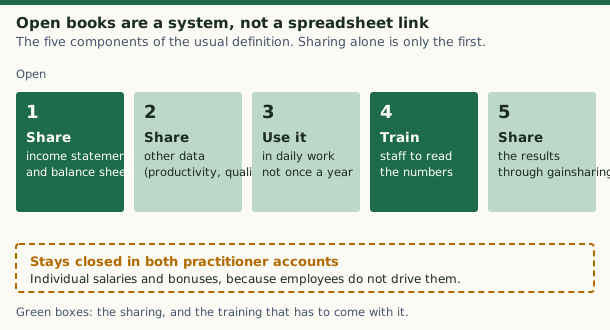
The National Center for Employee Ownership (NCEO) breaks the practice into five components, which is the version most other accounts follow2:
- Sharing the income statement and balance sheet with most employees2.
- Sharing other data, such as productivity and quality figures2.
- Encouraging employees to use the information in their daily work2.
- Training employees to understand financial numbers2.
- Sharing the financial results through a gainsharing program2.
The Great Game of Business, which offers coaching and workshops in the method1, insists the point is not the disclosure: open-book is not just about opening financials; it is about responsibility, ownership, results and growth1. It calls the method a discipline developed over time, not a one-time fix1. That matches a practitioner’s warning that there is no standard approach to exactly what OBM is, so counting companies that practise it is impossible4.
Why financial transparency is important to the people doing the work
The case for sharing starts with an assumption about what employees believe. When financial information is unknown, people assume their hard work is making the company a great deal of money, of which they see little1. Showing the numbers replaces that assumption with a measurement. The same source puts the bet in one line: give everybody a voice in how the company is run and a stake in the financial outcome, good or bad1.
What does the shared information actually do in a month? Four things show up repeatedly.
- Variances get investigated. Variances are observed, and the team can troubleshoot to determine what accounts for them1.
- Benchmarks stay in view. Having people look at the benchmarks regularly ensures that those numbers are hit1.
- Trends make the direction visible. Trends tell the story in a larger context, allowing everyone to see where the company is headed1.
- Forecasting becomes shared. A big part of opening the books involves forecasting future financial numbers, which gives the numbers a use beyond reporting1.
The practice also gives each company a focus number. The Critical Number is the one thing that most clearly defines “winning” for the company1. NCEO’s version is the “critical numbers” idea: factors that drive success but do not necessarily show up directly on the income statement2. The point of both is that people focus on numbers they can control, not on abstract entries on the financial statements2.
What gets shared, and what stays closed
Open does not mean everything. The information shared is only what is necessary for employees to see how their tasks affect the company, and every organization has slightly different numbers it focuses on1. Salaries and bonuses are not shared, because employees do not affect them1. The small-company case below makes the same cut: just about every financial number is discussed, and individual salaries are not2. The owner’s reasoning was that sharing salary information can too easily lead to resentment2.
Teamshares, whose network companies are employee-owned, offers a counter-balance to the “share less” instinct. Its approach shares revenue, gross profit and operating profit3. Generally, the more open the company can be with the statistics that affect its financials, the better, because it builds trust1.
The evidence: what the NCEO study found
The best-known research is the NCEO’s. Companies that shared such information with employees experienced a one to two percent annual increase in sales growth over what would normally have been expected2. The method matters for how far to trust that:
- The NCEO matched 50 to 54 companies that had practised open-book management for at least three years with three to five competitor companies, matched on SIC code, number of employees and sales volume2.
- It compared sales and employment growth before and after the year each company began, and attributed the difference to open-book management2.
- The attribution holds only if something else did not happen at the same time the system was started2.
The results split by ownership. Companies without employee ownership saw sales rise 1.66% per year and employment 1.27% per year relative to expectation; employee-owned companies did better, at 2.21% for sales and 1.14% for employment2. The NCEO’s own reading is that employee-owned companies would be nearly twice the size normally expected after 30 years2.
Worked example (our arithmetic): what those growth increments compound to over 30 years (annual increments from2; compounding is ours)
| Group | Annual sales increment | 30-year multiple |
|---|---|---|
| Not employee-owned | 1.66% | 1.0166^30 = 1.64 |
| Employee-owned | 2.21% | 1.0221^30 = 1.93 |
The second row reproduces the NCEO’s “nearly twice” figure, which is a useful check that the number is plain compounding and not a separate finding. Read the whole result carefully: the sample is small and self-selected, the companies had practised the method for years before they were measured, and a growth advantage of one to two percent is real money but not a rescue plan. Nothing here shows that opening the books alone causes growth. The sources that sell the method describe the education and incentives as inseparable from the sharing1, 4.
A small-company case: Pool Covers
The clearest published case in the NCEO account is a company with 26 employees that installs swimming pool covers and is the largest independent company in its industry2. Its timeline: a participative management program in 1993, open-book management in 1996 and an employee stock ownership plan (ESOP) in 19972.
Three details are useful to any finance lead.
- The owners were nervous. At first, little information was available to employees, partly because of concern that the numbers did not look very good2. Financials were shared semi-annually in 1996, and are now given out every month2.
- The numbers were taught, not just posted. A weekly staff meeting covers one or two items from the financial statement in depth2.
- The incentive attached to a controllable number. “Go-backs”, the return trips an installer has to make to finish an installation, were costing over $100,000 a year2. Employees would receive 50% of the savings in bonuses, up to a maximum of $54,000, and in the first year $20,000 in bonuses were paid out2.
The case ends with a profit figure: profits on sales grew from 0.4% before the ESOP to 3% after2. The company started an ESOP and open-book management within a year of each other, so the account cannot separate the two effects.
How to get started in your business
The sources agree on a short list of conditions, and finance owns most of them.
Leadership has to commit first. Leaders must be fully committed to transparency and willing to share information openly4.
Reporting has to change. As OBM is company-wide, a standard accounting programme is unlikely to suffice for reporting; what is required is a management-based approach, not a compliance-based one4. The finance team’s job is to build a one-page view that a non-finance employee can read, with the same definitions every month.
Education comes before disclosure. Open books only offer value after the company has provided financial literacy training4. Teamshares frames the practice as three things done together: sharing the financials regularly, educating employees on core topics and giving teams the tools to interpret them3. Its employee owners attend monthly meetings that combine financial education, performance discussion and actionable takeaways3. When employees are financially fluent, they make better day-to-day decisions3. One example is a service writer who noticed unusable old air filters and worked with a vendor to sign off on a return3.
Two tests show it is working. One practitioner argues a company should not call itself open-book unless there is an educational program for all employees covering both strategy and the financial drivers, and evidence that all staff understand the correlation between what they do and the company’s performance4. The same source adds that frequent communication channels have to carry financial updates, strategic plans and performance metrics4.
Rewards should be team-based. The dominance of reward programmes should be on team performance, not individual recognition4. OBM does not create problem-solving by itself; it creates the environment where it can flourish4.
What a startup has to check first
Opening the books is a decision about information, and a startup holds information that is regulated.
Option holders. If a company issues stock options under SEC Rule 701, the exemption for offers and sales of securities under certain compensatory benefit plans5, it must deliver a copy of the plan to the people receiving them5. If the aggregate sales price of securities sold in any consecutive 12-month period exceeds $10 million, it must deliver additional disclosure, including financial statements, a reasonable time before the sale5. Those financial statements must be dated no more than 180 days before the sale5, and for a stock option the disclosure is due a reasonable period before exercise5. A company that already shares statements with option holders can find this requirement easier to meet; one that has been secretive has to build the habit. Stock option rules cover the thresholds in detail.
Public companies. The SEC’s Regulation FD addresses selective disclosure6. It applies when an issuer discloses material nonpublic information to certain persons, in general securities market professionals and holders of the issuer’s securities who may well trade on the basis of the information, and requires public disclosure of that information6. A public company that wants to open its books to stock-holding employees needs counsel to check that rule and the insider-trading rules before the first meeting. This page is education, not legal advice.
Employee ownership. An ESOP is a qualified defined contribution plan that must be designed to invest primarily in qualifying employer securities7. It is a separate legal structure from open-book management; the case above had both, and the IRS account covers only the plan7.
The finance lead’s version
The sources describe the culture. The finance function supplies the machinery: a monthly close that arrives on a fixed date, a one-page view per team, a small set of critical numbers and a short training session each month. If the monthly numbers are late, wrong or redefined every quarter, the practice collapses, because the education rests on the numbers being stable. How finance matures shows which stage of the function can carry this, and the answer for most startups is the second stage at the earliest.
One test before starting: pick a single team and a single number it can influence, share that number monthly for a quarter and see whether anyone acts on it. Quill’s support team, from the start of this page, could begin with gross profit by account tier. If agents start asking about discounts before offering them, the practice has started to work.
If this left you with a question, start with Startup annual budget: how to build one, with example or Startup board financial package: what to include.
Sources
- Open-Book Management, FAQs & Explanations · The Great Game of Business · greatgame.com · checked October 22, 2026
- Open-Book Management · National Center for Employee Ownership · nceo.org · checked October 22, 2026
- The impact of open-book management in small business (November 14, 2025) · Teamshares · teamshares.com · checked October 22, 2026
- An Introduction to Open Book Management (July 12, 2023) · Sean Foster · seanfoster.co.nz · checked October 22, 2026
- 17 CFR 230.701, Exemption for offers and sales of securities pursuant to certain compensatory benefit plans · eCFR (U.S. Securities and Exchange Commission rule) · ecfr.gov · checked October 22, 2026
- Final Rule: Selective Disclosure and Insider Trading (Release 33-7881, August 15, 2000) · U.S. Securities and Exchange Commission · sec.gov · checked October 22, 2026
- Employee stock ownership plans (ESOPs) · Internal Revenue Service · irs.gov · checked October 22, 2026
Published . Rules and rates change: each source shows the day it was read. Education only, not advice. How we check facts · Report an error.