Marlow, a made-up software company with a Series A behind it, hired its first full-time CFO on a Monday. By Friday the finance lead had asked for a payroll sign-off, the CEO wanted a hiring plan, an investor wanted the data room, and the bookkeeper had a question about a vendor invoice. Every item was reasonable and none of them was the same size. The problem a startup CFO has is not a shortage of work; it is that the work arrives in the order of who is loudest.
This page gives a weekly system: what the calendar fixes, how to sort what is left, how many hours the job needs at each stage, and a worked week with the arithmetic shown. It sits in the team section, and it leans on the annual budget and how finance matures for the work that fills the protected blocks.
What a startup CFO’s time goes to
The job changes with the company, and the clearest split is between a large finance department and a small one. At a VC-backed startup the CFO role is hands-on and operational, less about managing a large department and more about being the financial co-pilot to the CEO5. One finance-services firm lists the core work as modelling and scenario planning, fundraising support, cash flow management, board and investor reporting, budgeting and forecasting, and strategic finance decisions5.
The U.S. Bureau of Labor Statistics data on the underlying occupation matters for time in two ways: financial managers spend much of their time analyzing data and advising senior managers on ways to maximize profits1, and most work full time, with some working more than 40 hours per week1. Its role list shows where the hours can leak. Controllers often oversee the accounting, audit and budget departments1; treasurers direct an organization’s budgets to meet its financial goals1; cash managers monitor and control the flow of money into and out of an organization1. At a startup one person covers all three until the team grows, which is the stage-two generalist described in how finance matures.
Not everything on a finance desk is the CFO’s. Tax preparation, tax filing and audit are CPA functions, and a good startup CFO works alongside the CPA firm5. A CFO who keeps those tasks pays executive rates for clerical hours.
Start with what the clock fixes
Some work has a date attached, and no sorting method changes it. Put these in the calendar first, before any priority discussion, and assign each to a named person so the CFO is the backstop and not the doer.
| Item | When it is due | Source |
|---|---|---|
| Form 941, employer’s quarterly federal tax return | April 30, July 31, October 31 and January 312 | IRS |
| Extra days to file Form 941 | 10 additional calendar days if every tax was deposited on time2 | IRS |
| W-2 copies to employees | January 312 | IRS |
| Form 1099-NEC to the IRS and recipients | January 312 | IRS |
| Monthly depositor: payroll tax deposit | The 15th day of the following month2 | IRS |
| Next-day deposit rule | Next business day once $100,000 or more accumulates on any day2 | IRS |
| Corporate estimated tax | Payments expected if the company will owe $500 or more at filing3 | IRS |
Two details change how the week is planned. Deposits move to the next business day when the due date falls on a weekend or legal holiday2, and federal tax deposits must be made by electronic funds transfer2, so someone with banking access has to be available on the day. The IRS due-date page sets which depositor schedule applies; the estimated tax page covers the corporate threshold. This is education, not tax advice; the CPA confirms which forms apply to the company.
Sort the rest by urgency and importance
Everything the calendar does not fix goes through the Eisenhower method, which organizes workload by importance and urgency9. It comes from a line attributed to Dwight D. Eisenhower: “I have two kinds of problems, the urgent and the important. The urgent are not important, and the important are never urgent.”9. Tasks fall into four quadrants and are handled differently: important and urgent tasks are done immediately and personally, important and not urgent tasks get an end date and are done personally, unimportant and urgent tasks are delegated, and unimportant and not urgent tasks are dropped9.
For a CFO the quadrants look like this:
| Quadrant | Typical Marlow item | Action |
|---|---|---|
| Important, urgent | A payroll funding shortfall before the deposit date | Do it now, personally |
| Important, not urgent | The rolling forecast, the next hire’s business case, the data room | Put a date on it and protect a block |
| Urgent, not important | A vendor invoice question, a report format request | Delegate to the controller or bookkeeper |
| Not urgent, not important | A weekly report nobody reads | Stop sending it |
The second row is where startup CFOs lose time. Work that is important but not urgent never forces itself onto the calendar, so it only gets done if the CFO books it. An annual plan is the standard example: the budget sets the baseline that every monthly review compares against, and it never gets built in the gaps between interruptions.
Pick a method that fits, and test it for a while
No single time-management method suits every founder; the Founder Institute’s research on founders found that there is no one-size-fits-all solution7. Its list of popular frameworks is a fair menu for a CFO too7:
- Eisenhower matrix, above, for deciding what deserves the hour.
- Time blocking with batching, which schedules specific blocks of time for different tasks, ensuring focused attention and minimizing distractions7. It suits month-end review, forecast building and board prep.
- The 80/20 rule, which focuses on the most significant tasks or activities that yield the highest results and prioritizes them over less impactful ones7.
- The Pomodoro technique, a timer of typically 25 minutes of work followed by a break of typically 5 to 10 minutes, with a longer break of typically 20 to 30 minutes after four pomodori10. It works for the dense analytical stretch, such as reconciling a variance.
The same source adds two practical rules: give a method a generous trial period and room for adjustment7, and exercise it together with the team to foster accountability7. A CFO who blocks Thursday morning for the forecast but never tells the CEO will see the block eaten by Friday.
A worked week (our arithmetic)
The figures below are made up for Marlow, a Series A company in a board month. They show the method, not a benchmark; no source in this research splits a CFO’s week by task.
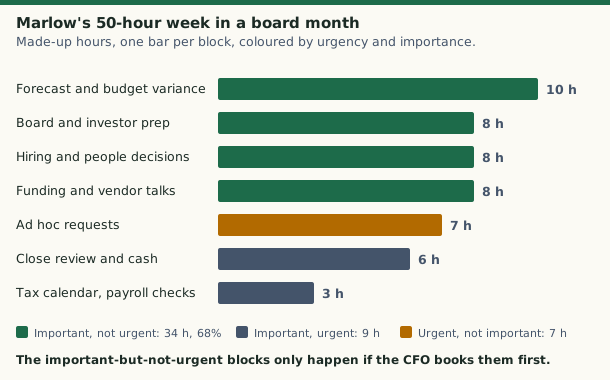
Worked example (our arithmetic): Marlow’s 50-hour week in a board month
| Block | Hours | Quadrant |
|---|---|---|
| Close review and cash position | 6 | Important, urgent |
| Board and investor prep | 8 | Important, not urgent |
| Forecast and budget variance | 10 | Important, not urgent |
| Tax calendar and payroll checks | 3 | Important, urgent |
| Hiring and people decisions | 8 | Important, not urgent |
| Funding and vendor negotiations | 8 | Important, not urgent |
| Ad hoc requests | 7 | Urgent, not important |
| Total: 6 + 8 + 10 + 3 + 8 + 8 + 7 | 50 | |
| Important, not urgent: 8 + 10 + 8 + 8 = 34 hours; 34 ÷ 50 | 68% | |
| Ad hoc requests: 7 ÷ 50 | 14% |
Two numbers matter. Marlow’s CFO spends 68% of the week on important work that no one is shouting for, which is where a finance function earns its place. And 14% goes to requests that could be delegated, so the first lever is a rule that ad hoc questions go to the controller. If the ad hoc share creeps toward a quarter of the week, the usual cause is that nobody else has been given the authority to answer.
How many hours the job needs
Before Series C the strategic part of the job often fits in fewer hours than a full-time salary buys. One firm that sells fractional services puts it at 10 to 20 hours per week of actual strategic finance work at the stage most startups are in5. A fractional or outsourced CFO is an experienced finance professional who works with a company part-time, typically a set number of hours or days per month, and the engagement can scale up during fundraising and down during quieter periods5. The same source, which has a commercial interest, places most VC-backed startups at this decision point somewhere between seed and Series A5.
A part-time CFO is not a lighter version of the job. A part-time CFO can help a startup in four essential ways: stewardship, operations, strategy and creating long-term business value6. Most startups do not need a full-time chief financial officer6. The hours the CFO keeps are the strategic ones, so the time-management system above matters more with fewer hours, not less.
Budgeting the cost of CFO time
CFO time has two prices: the salary and the opportunity cost of what the CFO is not doing. On salary, the sources differ by purpose and by sample, so read them as ranges and not as a standard.
- A full-time CFO typically costs $200K to $350K or more in total compensation, against $3,000 to $10,000 per month for a fractional CFO, from a firm that sells the fractional model5.
- The U.S. Bureau of Labor Statistics reports a median annual wage of $166,570 for financial managers in May 2025, across all industries and company sizes1. Financial managers typically need a bachelor’s degree and 5 years or more of experience in another business or financial occupation1.
- The Journal of Accountancy reports an executive search firm’s 2025 study of 312 CFOs: the most common base salary at middle-market companies as $350,000 to $399,000, and $250,000 to $299,000 under $100 million of revenue4. Middle-market means $100 million to $500 million of annual revenue in that survey4.
The choice is not only about price. A full-time hire also takes a 3 to 6 month executive search plus onboarding, a delay the fractional route avoids, a point worth discounting because the source sells that route5. The full-time cost is also fixed in quiet quarters, while a fractional engagement flexes5. The annual budget is where the company decides which of those it can carry.
The first 90 days
A new CFO’s calendar is its own problem, because everything is both new and urgent. One SaaS-finance guide frames the choice up front: outline how to balance the tactical and strategic elements of the role8. Its four areas fit the sorting rule above.
- Financial software. Choosing the right financial software is one of the biggest strategic decisions to make in the first 90 days8. It is important and not urgent, so it needs a date and a block.
- CAC. Get familiar with the organization’s customer acquisition costs, which can be packaged differently across companies8.
- Free cash flow. When it is negative, runway is limited by the free cash flow burned every year8. Burn rate and runway shows the arithmetic.
- People and process. Build a level of trust to look at data without defence if the goal is a cohesive executive leadership team8.
The CFO seat has evolved from technical expertise with a narrow financial focus to business partner with strategic and operational focus8. A practical reading: the 90-day plan is a list of important and not-urgent items, and the first job is to defend the blocks for them from the urgent ones. Board reporting covers the first deliverable that deadline-driven work will produce.
Common questions
How much does a CFO at a startup make?
A full-time CFO typically costs $200K to $350K or more in total compensation, and a fractional CFO ranges from $3,000 to $10,000 per month, from one finance-services firm that sells both5. The U.S. Bureau of Labor Statistics median for all financial managers is $166,570 (May 2025), with the lowest 10 percent under $94,310 and the highest 10 percent above $323,2701.
What is the typical salary for a CFO in a $100 million company?
In a 2025 survey of 312 CFOs, the most common base salary at middle-market companies, defined as $100 million to $500 million of revenue, was $350,000 to $399,000, with standard bonuses of 50% to 59% of base4. Under $100 million the most common base was $250,000 to $299,0004.
Read next
Finance operations
Scaling startup finance: five stages, roles and costs
How startup finance scales: five maturity stages, signals it is time to upgrade, controller and CFO roles, G&A benchmarks, CFO pay and the audit horizon.
Finance operations
Startup annual budget: how to build one, with example
How to build a startup annual budget in six steps: revenue drivers, fixed and variable costs, headcount, cash, a SaaS spend benchmark and a worked example.
Boards and reporting
Startup board financial package: what to include
What a startup board financial package contains: three statements, a short KPI set, burn and runway, budget-versus-actual variance and a narrative.
Sources
- Financial Managers, Occupational Outlook Handbook · U.S. Bureau of Labor Statistics · bls.gov · checked October 22, 2026
- Employment tax due dates · Internal Revenue Service · irs.gov · checked October 22, 2026
- Estimated taxes · Internal Revenue Service · irs.gov · checked October 22, 2026
- The expected salary range for middle-market CFOs · Journal of Accountancy (AICPA) · journalofaccountancy.com · checked October 22, 2026
- CFO for Startups: Do You Need Full-Time, Fractional, or Outsourced? · Countsy · countsy.com · checked October 22, 2026
- 4 Things a Part-Time CFO Can Do for a Business Startup · Redpath and Company · redpathcpas.com · checked October 22, 2026
- Navigating Time: How to Select the Right Time Management Method as a Startup Founder · Founder Institute · fi.co · checked October 22, 2026
- 4 priorities during your first 90 days as a SaaS CFO · Sage · sage.com · checked October 22, 2026
- Time management · Wikipedia · en.wikipedia.org · checked October 22, 2026
- Pomodoro Technique · Wikipedia · en.wikipedia.org · checked October 22, 2026
Published . Rules and rates change: each source shows the day it was read. Education only, not advice. How we check facts · Report an error.