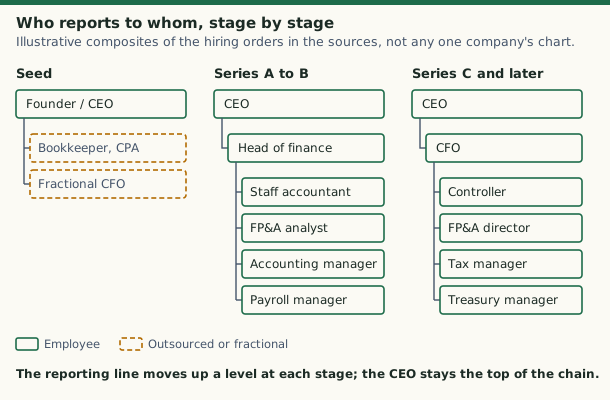
Cairn, a made-up software company, grew from a founder with a bookkeeper to a team of specialists without anyone drawing the chart. Within a year the controller was reviewing the head of finance’s journal entries, the FP&A analyst had two bosses, and nobody could say who signed off on the board numbers. Titles had been handed out in the order people were hired, not in the order the work needed them.
A finance team structure is that chart drawn on purpose: which functions exist, who leads each, who reports to whom and when each seat opens. This page covers structure. How finance matures stage by stage, and what a team costs, is on scaling startup finance; the hours a CFO has to divide among all of it are on CFO time management; the package the team produces for directors is on board reporting. It sits in the team section.
What is the typical structure of a finance team?
There is no single model. Structure depends on the size and phase of the business, and on reporting complexity, regulatory obligations and international expansion4. What is stable is the set of functions the structure has to cover, and the sources agree on six of them4.
| Function | What it does | Source |
|---|---|---|
| FP&A | Gives the organization the insight for informed decisions through budgeting, forecasting and strategic planning | 4 |
| Accounting | Oversees the month-end close, financial reporting and regulatory obligations, keeping records accurate and compliant | 4 |
| Treasury | Manages cash flow, liquidity planning and working capital | 4 |
| Tax | Supports tax compliance and manages tax risk | 4 |
| Payroll | Pays employees accurately and on time and keeps payroll compliant with employment law | 4 |
| Revenue operations, where applicable | Aligns financial and commercial data to improve revenue forecasting | 4 |
Not every company has all six as separate teams. In small organizations, finance responsibilities are typically shared between founders, office managers or a single finance professional4. Before the first full-time hire, finance is typically founder-led or outsourced1. Functions get their own dedicated teams only later; at larger companies treasury, tax, procurement, audit and compliance, and revenue operations each have one1.
The two big halves scale at different speeds. Accounting is the muscle and strategic finance is the brain1, and across the sample accounting headcount typically outpaces FP&A as companies scale1. The reason sits in the next sections: the close cannot slip, while planning can pause.
What is the hierarchy of finance positions?
The ladder forms as the team does. Titles start to ladder from analyst to manager to director, and who does what by when is written down rather than implied1. The top of that ladder differs by stage, which is why the same job can carry three titles in three companies.
| Level | Typical title | What the level owns | Source |
|---|---|---|---|
| Executive | CFO | Accuracy of the organization’s financial reporting; on the executive team at larger companies | 6,1 |
| Leader below the C-suite | Head of finance, VP of finance | Seniority without a C-suite title, which is why some first hires prefer it | 3 |
| Function head | Controller | Directs the preparation of financial reports and often oversees accounting, audit and budget | 6 |
| Function head | VPs of FP&A, accounting, treasury, strategic finance | One VP per function, each supported by a director | 1 |
| Middle | Director, manager | Directors have managers and analysts under them | 1 |
| Individual contributor | Analyst, staff accountant | Transaction processing, payroll and basic reporting in the first teams | 2 |
| Specialist | Cash, credit, risk, tax and treasury roles | Narrow ownership: cash flow, credit standards, financial risk, tax strategy | 6,4 |
A few of these definitions are worth reading closely. A controller is the person who directs financial reports that summarize and forecast an organization’s position6. Treasurers, credit managers, cash managers and risk managers are the other specialist leaders in the federal occupational data6. A financial controller is also a senior management role over all functions of the finance and accounting department4, a treasury lead owns capital, liquidity, funding and financial risk4, and a tax manager owns tax strategy, compliance and reporting obligations4.
Depth changes with size. A company with more than 500 employees typically has around 50 full-time finance staff and a hierarchy spanning four to five levels1. A mid-sized startup has two or three of those levels. The path to the CFO seat runs through the lower rungs: financial managers typically need a bachelor’s degree and five years or more of experience in another business or financial occupation6, and experienced financial managers may advance to chief financial officer6.
Who reports to whom
Reporting lines answer three questions: who leads, who signs and who can say no.
Who leads. In the first structured team, work that lived with one person or an outside firm splits into lanes: a finance lead to set the reporting and forecasting cadence, a controller to run a reliable month-end close, and FP&A to connect plan to reality and build the board pack1. The finance lead sits on the executive team at larger companies1. The chart on this page draws those role lists as an org chart; the reporting lines in it are our drawing, because the sources list roles and not lines.
Who signs. For companies that file periodic reports with the SEC, the rule is explicit: each principal executive officer and each principal financial officer must sign a certification7, and neither may have it signed on their behalf under a power of attorney7. The SEC rule text covers public issuers and does not bind a private startup, but it fixes the logic of the structure: the person responsible for reporting accuracy is a named officer, which matches the description of a CFO as responsible for the accuracy of an organization’s financial reporting6.
Who can object. A control needs someone other than the person who made the entry. Two structural mistakes remove it: over-relying on one person, which creates operational risk and limits scalability4, and blurred responsibilities, because confusion creates chaos while clearly defined roles improve accountability4.
How wide a manager’s span is. A manager shouldn’t have more than four to six direct reports3. Once the team reaches five people or more it is time to move toward specialized roles3, so the first reporting layer and the first specialists tend to arrive together.
Finance team structure by company size
The size benchmark used here is Aleph’s sample of 218 Y Combinator B2B companies, with 3,597 finance records across 2,075 titles1. Its main caveat is the sample itself, which is venture-backed software companies; a services or manufacturing business will differ.
| Company size | Average finance team | Finance team as % of company | Source |
|---|---|---|---|
| 5–50 employees | 0.35 people | 1.3% | 1 |
| 51–250 employees | 5.29 people | 3.5% | 1 |
| 251–500 employees | 10.86 people | 2.9% | 1 |
| 500+ employees | 49.2 people | not given | 1 |
The ratio climbs steeply from 5 to 250 employees and then tapers off as companies approach 5001. Between 51 and 250 employees organizations are in their “build the machine” phase1. In the lowest band, the sample includes companies with zero in-house finance hires, almost all of them between 5 and 50 employees1. Only about 17% of companies in that band show an internal finance employee, mostly at the later end of the range1. And headcount is not readiness: the sample includes companies with 100 or more employees and zero internal finance1.
Robert Half’s four stages cover the same ground for a broader set of companies and agree on the shape. A startup of 1–50 employees shares the work among founders, office managers or one finance professional4. A growth-stage company typically introduces specialist roles to improve reporting, budgeting and financial control4. In larger organizations, finance functions are highly specialized with clearly defined responsibilities across multiple teams4.
When should a startup make its first finance hire?
Most companies make the first full-time finance hire late in the 30–50 employee range1. The first structured team appears at the 50-employee mark, which is a key inflection point: just about every company then has at least one full-time finance or accounting person, and the mandate shifts from staying afloat to creating structure1. A separate guide puts the threshold for a full-time accounting or finance team member at about 25 people3. The most successful startups hire for their next 18 months of growth2.
Early hires tend to be a player-coach CFO or head of finance, or a controller or accounting manager who can own the close while leadership focuses on growth and runway1. Ramp’s CEO did the work himself for a year and a half before the first finance hire3.
The risk runs both ways. Hiring full-time staff too early is a common pitfall2, and so is hiring too senior too early: most Series A companies are not ready for a full-time CFO2, and appointing executive-level roles prematurely can increase costs without delivering the expected value4. Waiting too long has its own price: leaders without forecasting and planning capability lack the insight to make informed decisions4.
First-hire archetypes
The ideal first hire mixes accounting and investor-relations experience, but because such candidates are rare, the common archetypes are what a founder will meet3. The first finance hire used to come from accounting, as companies worried most about the quality of their books3. It is now much more common for that person to have an investment banking or venture capital background3, because the role has become more external-facing: it is oriented toward securing scarce capital3.
Three archetypes recur in the Stripe Atlas guide:
- The scrappy rookie, a relatively recent graduate, about five years out of school, with a traditional finance background3.
- The unconventional candidate, a prospect with an atypical background and a fast learner’s aptitude for logic and problem-solving3.
- The seasoned pro, the experienced candidate who has seen it all3.
The first two pair well with an outsourced accounting firm that understands the nuances of GAAP and accounting systems3. That pairing is the point: the outside firm covers technical accounting and the internal hire focuses on strategy. FP&A hires carry a communication trait as well; an operator interviewed on the subject recommends prioritizing effective communicators with a skill for storytelling5. For the other half of the skill, see data storytelling for finance teams.
Should the first hire be a controller or FP&A?
There is no hard rule; the working one is to hire to the pain1. If the biggest issue is a lack of visibility, such as cash forecast, budget-versus-actual discipline or board pack quality, hire an FP&A leader first; if it is compliance volume, such as invoices and payroll, start with a controller1. The surprise in the data is how often the pain is visibility: in 20% or more of cases FP&A hires appear before a controller1.
Not everyone agrees on the order. The Stripe Atlas guide recommends getting accounting into good standing first, because the accounting foundation and the integrity of the data have to be there before an FP&A professional can deliver outsized value3. Brex expects the opposite sequence at Series A: a head of finance first, accounting as a flex resource with the right outside firm, and no controller yet2. The two orders end up in the same place: by the time a company crosses 50 employees, it should probably have both1.
For reference, the roles themselves have clear triggers. A controller fits when reporting requirements become more complex, the business is preparing for external audits or investment, internal controls need formalizing and headcount and transaction volumes are increasing4. An FP&A manager fits when budgeting and forecasting become increasingly complex, leaders want more detailed performance reporting, strategic planning becomes a priority and multiple business units or revenue streams emerge4.
In-house, fractional or outsourced
Year one is about starting the function from scratch, with four common options: outsource it, treat it as a part-time job for a senior executive, onboard a controller or hire a head of finance3. Each trades control for cost.
| Option | When it fits | Source |
|---|---|---|
| Outsourced bookkeeping and tax | Most pre-seed and seed startups; a combination of outsourced bookkeeping and a part-time CFO rather than an internal team | 2 |
| Part-time duty for a senior executive | A temporary solution until a fractional or full-time hire | 3 |
| Controller | Brings accounting entirely in-house | 3 |
| Head or VP of finance | A full-time first hire, often titled to confer seniority without the C-suite | 3 |
| Fractional CFO | Between seed and Series A rounds | 3 |
At pre-seed the typical need is tax and accounting work, not a CFO3. A full CFO in a business’s nascent stage is overkill3. For the accounting part, the U.S. Small Business Administration lays out the cost trade: a CPA typically costs more than online services but offers more tailored service, and a bookkeeper provides basic day-to-day functions at a lower cost without the formal accounting education of a CPA8. Outside help with accounting comes in three forms on the SBA’s finance page: a CPA, a bookkeeper or an online service8.
Outside help has a limit. Fractional finance hires are a more viable first-hire option than they used to be3, and tax and project-based work don’t always require full-time expertise, so contract support can fit4. But the guide’s year-four advice is the mirror image: after the three-year mark or once the team reaches 25 people, establish an in-house tax function3.
Hiring by funding stage
Brex sorts the hiring order by amount raised, which is a rougher but more familiar yardstick than headcount. Treat the labels as ranges that companies move through at different speeds.
| Stage | Typical profile | Finance seats | Source |
|---|---|---|---|
| Pre-seed and seed | Lean; outsourced bookkeeping plus a part-time CFO | None in-house | 2 |
| Series A (~$5M-$15M raised) | Several million dollars raised and up to 50 employees | Head of finance, staff accountant | 2 |
| Series B | Revenues surging into eight figures | Accounting manager, FP&A analyst, additional staff accountant, payroll manager | 2 |
| Series C and later | International expansion, M&A, exit planning | CFO, controller, tax manager, treasury manager, more FP&A and accounting | 2 |
Series A is where the first leader arrives. The first key finance hire is typically a head of finance or, at least, someone with a finance and operations background2, complemented by a staff accountant who handles transaction processing, payroll management and basic reporting2. At Series B the accounting manager becomes essential for managing accounting operations, building internal controls and preparing for audits2, and an FP&A analyst goes deep on financial modeling, the budget and board reporting2. At Series C a seasoned CFO is due if the company does not have one2, and a controller becomes essential to oversee accounting operations and ensure audit-ready financials2.
The Stripe Atlas guide runs the same sequence by year: FP&A in year two3, specialists after the team reaches five people3, a payroll specialist at 150–200 employees3 and a CFO after the company raises its Series D3. Payroll support is needed from the outset for international hiring and can be outsourced below 150 employees3.
Where industry changes the structure
The ladder above is for a typical software company. Sector and geography shift it. SaaS and subscription businesses may need revenue recognition expertise to manage multi-year contracts2. Fintechs likely need to hire earlier for treasury, compliance and risk roles2. Companies that operate globally should look at an on-site finance team with local expertise to handle the regulatory and operational rules of new markets3. Remote hires can benefit from a payroll specialist who manages the technicalities of making hires from different states and countries3.
The finance team is also the company’s reality check, ensuring that strategies are financially viable and align with the company’s vision5. That job depends on one number being right everywhere: a finance lead should ask where definitive figures such as ARR or unit economics originate5, and validate them with the revenue operations and data teams before they are reported5. ARR versus MRR shows why that definition has to be fixed in writing.
Specialized units follow the same logic as sizes. Ramp now hires specialists staffed for a single function3 and organizes finance pods that support sales and marketing, G&A and R&D3. The structure is by customer of the work, not only by function.
How the work changes as layers appear
Each new layer changes what the team produces, and the change is the real reason for the seat. At 51–250 employees the day-to-day rhythm becomes more predictable: monthly close, budget versus actuals and a board pack blueprint1. The close belongs to accounting, the board pack to FP&A and the cadence to the finance lead1.
At 251–500 employees finance owns the operating rhythm, with rolling reforecasts, scenario modeling and OKR support, and works shoulder to shoulder with go-to-market, product, HR and operations1. Two effects follow in the same band: dashboards replace static decks1, and decisions happen faster because the numbers are trusted1.
That progression gives a usable test for the next seat. The question is whether the work has a recurring output without a named owner, not whether the company has reached a size. Prioritize positions that can strengthen decision-making, financial control and business performance, and not headcount for its own sake4. Finance hiring is not linear either: some companies start with a CFO early, and others rely on fractional support until Series B1.
Systems that change the headcount
Tools change what the team needs to hire. Automation changes how a team operates3, and the tools a company picks could have a big impact on the functions it needs to hire3. Removing tasks like invoicing, reconciliation and reporting frees finance professionals to focus on strategic work4. Ramp’s own team is the example from the vendor side: automation lets it hire fewer generalists while maintaining rigorous operations3, though the source sells that automation and the claim is its own.
In the first structured teams the system list is short: ERP and payroll to stabilize the close, basic BI tools that give leaders real-time visibility into KPIs, and a single source of truth that prevents confusion across departments1. Before the systems comes the paper. A company should document its core processes, from how it approves invoices and handles expense reports to how it pays contractors and closes the books each month2. And a company probably shouldn’t experiment widely with tools in its first three years3.
The structural point is that a system supports a seat and does not replace the person who owns the number. Where a figure such as ARR or unit economics originates, and who validates it before it is reported, is still a question for the finance lead and the revenue operations team5.
What to test in the first-hire interview
The Stripe Atlas guide carries sample interview questions that double as a structure test, because each one probes a different lane of the job. “What would you want to see from this company to understand its past?” probes how the candidate would attempt to understand the financial characteristics of the business3. “What’s the bull case for this company?” probes financial knowledge and reasoning by asking the candidate to forecast the future and explain the rationale3.
The interview itself needs room. It is vital, especially for the first hire, to leave a third to half of the allocated interview time for the candidate to ask questions about the business3. Whatever the background, core to the future success of a first hire are personality, adaptability and values fit3.
Structure mistakes that recur
Five patterns account for most of the structure problems in the sources, and each is a cost rather than a crisis until it is ignored.
- Hiring senior leaders too early, which raises costs without delivering the expected value4.
- Delaying FP&A, which leaves leaders without the insight for informed decisions4.
- Relying on one person, which concentrates operational risk4.
- Blurring responsibilities, which weakens accountability4.
- Over-bureaucratizing: as teams grow and processes become more formal, companies risk slowing decision-making and losing the nimbleness that helped them succeed2.
The remedies are plain: establish clear, repeatable processes before introducing additional roles or more complex structures4, and hire a mix of ambition levels, since a team of people all aiming for the same top job is a risk3. Basic hygiene helps at any size: keep business and personal finances separate and map expenses to proper categories to keep a clear paper trail2.
Worked example (our arithmetic): sizing and spans
Cairn has 120 employees. The inputs below come from the sources; the arithmetic is ours.
Worked example (our arithmetic): Cairn’s finance team size and structure
| Question | Calculation | Result |
|---|---|---|
| How are the benchmark ratios built? | 0.35 ÷ 27.5 (midpoint of 5–50); 5.29 ÷ 150.5 (midpoint of 51–250); 10.86 ÷ 375.5 (midpoint of 251–500) | 1.3%, 3.5% and 2.9%, which match the published column |
| Benchmark team at 120 employees | 3.5% × 120 | 4.2, so about 4 people |
| Same ratio at 200 employees | 3.5% × 200 | 7 people |
| Typical team at 100 employees | 5 ÷ 100 | 5% of the company |
| Does a 14-person team fit one manager’s span? | 14 ÷ 6 | 2.33, so at least 3 people must carry reports |
| Seats in Brex’s Series A to C list | 2 + 4 + 6 | 12 role slots |
| Against the 251–500 band | 12 role slots against an average of 10.86 | 12 is above the average, inside the 8–15+ range |
Three results matter. The 3.5% ratio gives a team of about four at 120 employees, below the roughly five found at 100 employees, so the benchmark is a range and not a target1. A 14-person team cannot all report to one lead, since a manager shouldn’t have more than four to six direct reports3. And the Series A-to-C list from Brex lands at 12 role slots, which matches a 251–500 company where orgs typically expand to 8–15+ roles1, so the funding-stage path and the headcount path describe the same team from two sides.
How to check a structure before hiring
Read the chart against the questions the sources use. Is every one of the six functions owned by a named person, even if the person is outside4? Does the lead sign the numbers the board sees, in the way a CFO is responsible for the accuracy of reporting6? Does any person hold more than four to six direct reports3? Has an executive-level role been added before the work needed it4? Do the controller and FP&A lanes both exist by the 50-employee mark1? Do the finance lead and revenue operations agree on where ARR originates before the board sees it5? Is the next seat tied to a trigger such as an external audit, an investment or international expansion4?
None of these questions has a right answer in the abstract. There is no perfect org chart by stage, and every company is different1. The test is whether the chart matches the work the company has today, and the hiring plan names the next role in the order the work needs it.
Common questions
What are the 5 steps of financial reporting?
None of the sources used here sets five steps. The reporting work they describe is closing the books on time, preparing monthly, quarterly and annual statements, producing investor and board materials, analyzing KPIs and reporting cash flow2. For public companies the chain ends in a certification signed by the principal executive and financial officers7.
Read next
Finance operations
Scaling startup finance: five stages, roles and costs
How startup finance scales: five maturity stages, signals it is time to upgrade, controller and CFO roles, G&A benchmarks, CFO pay and the audit horizon.
Startup equity
CFO time management at a startup: a weekly system
How a startup CFO manages time: what the clock fixes, how to sort the rest, hours the job needs, a worked 50-hour week, 90-day priorities and what it costs.
Boards and reporting
Startup board financial package: what to include
What a startup board financial package contains: three statements, a short KPI set, burn and runway, budget-versus-actual variance and a narrative.
Sources
- Finance team structure by company size (data from 218 startups) · Aleph · getaleph.com · checked October 22, 2026
- How to hire and structure a finance team for a growing startup · Brex · brex.com · checked October 22, 2026
- Building your startup's finance team · Stripe Atlas (guide by Ramp's CEO) · stripe.com · checked October 22, 2026
- Finance team structure: How to build and scale your department · Robert Half · roberthalf.com · checked October 22, 2026
- The Structure of High-Growth Startups' Finance · Personiv CFO Weekly · insights.personiv.com · checked October 22, 2026
- Financial Managers, Occupational Outlook Handbook · U.S. Bureau of Labor Statistics · bls.gov · checked October 22, 2026
- 17 CFR 240.13a-14, Certification of disclosure in annual and quarterly reports · eCFR (U.S. Securities and Exchange Commission rule) · ecfr.gov · checked October 22, 2026
- Manage your finances · U.S. Small Business Administration · sba.gov · checked October 22, 2026
Published . Rules and rates change: each source shows the day it was read. Education only, not advice. How we check facts · Report an error.