On this page
- Who sits on a startup board: three kinds of seat
- How many board members should an early-stage startup have?
- Seed-stage boards
- Series A boards
- Board composition by stage
- What is an independent director on a board?
- When to add an independent board member
- What are the disadvantages of independent directors?
- How the seats are written into the documents
- Worked example (our arithmetic): votes, shares and a director grant
- Building the right board for your stage
- Compensating board members
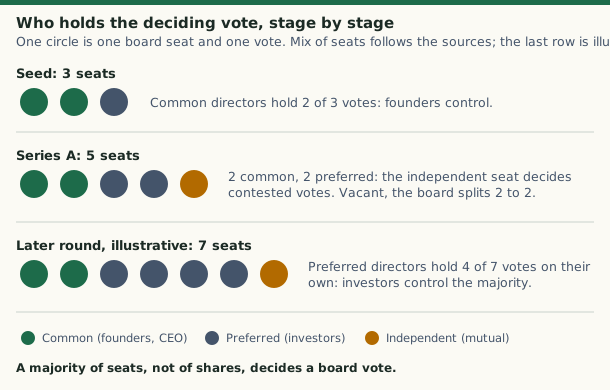
A board begins as whoever signed the incorporation papers and turns into a negotiated object the day an investor writes a check. Each seat has an owner and each owner has a reason to want it. Founders want to keep the right to run the company, the investor wants a vote on the decisions that move its money, and the company is better off with someone in the room who is neither.
This page covers composition only: which seats exist, how many, who elects each one, when an independent director joins and what the seats are paid. What the board does and what its members owe the company is on the board of directors page, and the financial package a board reads before each meeting is on board reporting. Both sit in the board section.
Who sits on a startup board: three kinds of seat
A startup board typically has a mix of founders, investors and independent directors2. The three are different legal objects, because each is elected by a different group of stockholders. The NVCA model voting agreement shows the pattern: holders of preferred stock, exclusively and as a separate class, are entitled to elect one director; holders of common stock elect two; and common and preferred voting together elect the balance7.
Investors get a seat through the stock they buy. Investors own preferred stock, and the right to appoint a director comes with it, so an investor who owns less of the company still gets a seat4. Ownership alone does not control the board: more stock does not mean control of the board4, because board seats represent governance power and shares represent economic power1.
| Seat | Elected by | Who usually holds it |
|---|---|---|
| Common director | Common stockholders, as a separate class7 | The CEO represents common shareholders3 |
| Preferred director | Holders of a series of preferred stock, as a separate class7 | A lead investor or their associate represents preferred shareholders3 |
| Independent (mutual) director | Agreement of the other seated members, in the NVCA model7 | An individual who is not an affiliate of the company or of any investor7 |
| Observer | Not elected; no vote4 | Often a founder who gave up a seat3 |
Observers have no vote, so they do not matter for board control4, though one source notes that an observer still has direct access to the decision-making process3.
How many board members should an early-stage startup have?
The law sets a low floor and leaves the rest to the company. A Delaware board consists of 1 or more members, each a natural person8. Seat count is a bylaw question, unless the company’s charter pins the number8. Owning stock is not a prerequisite for a seat unless one of those two documents makes it one8. A quorum is a majority of the total number of directors, unless the certificate or bylaws require more8. On a three-seat board, then, two directors make a quorum; on a five-seat board, three do.
Practice settles on small and odd. Early-stage companies typically start with three board members2, and the ideal size lands on an odd number, three to five, to avoid deadlocks in voting2. An odd number prevents tied votes, offers wide enough perspectives to make discussions valuable and keeps decision-making relatively simple3.
The range of possible boards is wider than the convention. FTX raised billions of external financing with a single board member, the founder-CEO5. That is the research’s example of how flexible private boards are, not a model.
Size also follows bargaining power. Where capital is abundant and entrepreneurs have strong bargaining power, boards tend to be under their control, with founders and executives occupying the majority of seats5.
Seed-stage boards
Seed boards are small and founder-heavy. A typical seed board has two founder-elected seats and, at most, one seat for the lead seed investor1. Seed-stage composition is typically founder-heavy, with perhaps one investor representative2. Capping the board at three people is often suggested3. Before any priced round, a pre-seed board can be founders only, with one, two or three founders making up the entire board4.
The financing documents write the structure down. A seed round’s documents typically provide that the board shall consist of two common directors, one of whom shall be the CEO, and a preferred director appointed by the majority of preferred shareholders or a specific VC firm that led the round4.
Convertible instruments change the answer. Seed investors who use simple agreements for future equity (SAFEs) usually receive no board seat at all1. How that instrument works is on the SAFE notes page.
Whether to add an independent at this stage has a short answer: most seed companies do not need a formal independent director1, and informal advisors can provide an outside perspective without the governance overhead of a formal seat1. Some investors skip the seat altogether and take an observer role at pre-seed4.
Series A boards
Series A is where a board gets its third constituency. At the Series A level a small board still makes sense, with either three or five people3. Preferred stock comes into existence with the round, so preferred shareholders, common shareholders and independents each need to be represented with a seat3.
| Series A board | Seats | Source |
|---|---|---|
| Three-person | One founder, one VC, one independent1 | CRV, describing law-firm practice |
| Five-person, as law firms describe it | Two founders, two VCs, one independent1 | CRV |
| Five-person, by preferred series | Two common, one seed preferred, one Series A preferred, one independent4 | Startup Hacks |
On a three-person board one founder leaves to make room for the preferred seat3. That founder can take an observer seat, which gives access without a vote3.
A vacant independent seat is common. Both sides frequently leave it vacant at closing, and the board then operates with founder-investor parity1. Another source describes the same two-two board and concludes that the founders effectively still maintain control4. The two accounts agree on the split and differ on who benefits from a tie.
The chair is a separate question. The CEO can also be the chairperson, although a separate chairperson can help maintain a separation of board and CEO interests3.
Board composition by stage
Control moves in one direction as rounds accumulate. Before the second VC financing round, entrepreneurs typically control startup boards; by the fourth round, most board seats are held by investors5.
| Stage | Typical board | Who controls | Source |
|---|---|---|---|
| Pre-seed | Founders only, 1 to 3 seats | Founders | 4 |
| Seed | 3 directors: 2 common, 1 preferred | Common directors | 4 |
| Series A | 5 directors: 2 common, 2 preferred, 1 independent | Shared; the independent decides | 4 |
| Second and third rounds | 2 investors, 2 entrepreneurs, 1 independent in a tie-breaking role | Shared | 5 |
| Series B and beyond | Investors have more representation | Investors | 4 |
The shared-control stage is the one where the independent seat earns its keep, and it is the next section’s subject. The investor-controlled stage is the one founders negotiate against from the first term sheet.
What is an independent director on a board?
An independent director is a director who has no employment relationship with the company and is expected to exercise judgment independently of the company’s investors1. A second definition adds the label some boards use: an independent director, also called a non-executive director, has no material relationship with the organization2. In practice that means no shares held, no employment and no personal or professional ties that could influence judgment or create conflicts of interest2.
Public companies have a rule. Under Rule 10A-3, each member of the audit committee must be a member of the board and must otherwise be independent9. To count as independent, a member may not accept directly or indirectly any consulting, advisory or other compensatory fee from the issuer or a subsidiary, and may not be an affiliated person of the issuer or a subsidiary9. The rule is written for listed issuers9. On a startup board the independent seat is not mandated by law5; it exists because the financing documents create it.
What the seat is for differs from the public-company model. The independent director’s primary job is to act in the best interests of common stockholders, including founders1. Research on startup boards finds that independent directors act as mediators, resolving potential conflicts between VCs and entrepreneurs5, and an earlier law-review analysis describes the tie-breaking seat as a practice of privately held startups6. Allocating the tie-breaking vote to an unbiased third party prevents opportunistic behavior by both founders and investors1.
Delaware courts apply a fact-specific independence test that goes beyond formal labels1. When a contested transaction receives approval from a majority of disinterested directors, courts apply the business judgment standard rather than the more demanding entire fairness test1.
When to add an independent board member
At seed, advisors do the job that a seat would1. Series A is the standard trigger, the round when independent directors typically become standard1. After a second round of financing it is fairly common to designate an independent seat, and by Series B the absence of one becomes a recognizable governance gap1.
The research shows when the independent seat carries a tie-breaking vote, and when it does not. Independent directors are less likely to have a tie-breaking vote when VCs and entrepreneurs have worked together in the past5. When VCs have a reputation for being heavy-handed in replacing startup executives, independent directors become a valuable resource for settling disputes5.
The person in the seat changes with the stage. Independent directors joining early are less likely to have interacted with either VCs or entrepreneurs in the past5, which is what a mediation role requires. In later stages, independent directors tend to have stronger connections with VCs, more executive-level experience and previous service on public boards5. Independent directors at this stage also review related-party transactions and serve on audit and compensation committees1.
For the search itself, the sequence is a gap analysis first. The search should begin by examining who already serves on the board and identifying the gaps1, and the skills to add are those that fill the gaps in the team’s knowledge2.
What are the disadvantages of independent directors?
The structure works only when the person is genuinely independent, and each drawback is a way that condition fails or a cost of meeting it.
- Independence in name only. A nominally independent director who defers to investors on every contested vote entirely defeats the seat’s structural purpose1.
- Selection by one side. In a split board with equal founder and investor seats, if the investor effectively controls who fills the tie-breaking seat, the board functionally favors investor interests even when the formal structure appears balanced1.
- Too early. Formalizing an independent seat too early introduces structural rigidity before the company has the operating discipline to benefit from it, and a board seat carries fiduciary duties that attach automatically under Delaware law1.
- Prestige without presence. A high-profile director who shows up disengaged provides no real governance function1.
- Fiduciary overhang. One academic analysis of the practice suggests that heightened fiduciary protections could undermine the role of the independent director in startup firms6.
- A seat that costs equity and, later, cash. The seat is paid, which the compensation section below sets out1.
None of these is an argument against an independent seat at the stage where sources treat it as standard. They are the conditions under which the seat stops doing its job.
How the seats are written into the documents
Board composition at venture-backed startups is enforced through binding legal instruments rather than informal agreements1. Two documents carry it. The certificate of incorporation sets which class elects which seat7. The voting agreement then binds stockholders: each stockholder agrees to vote, or cause to be voted, all shares owned or controlled, so the named people are elected7.
The NVCA model handles each seat differently. The CEO seat follows the job: if the CEO director ceases to serve as chief executive officer, each stockholder promptly votes to remove the former chief executive from the board7. The independent seat is the mutual director, an individual who is not otherwise an affiliate of the company or of any investor, designated by mutual agreement of the other seated members7. Mutual approval language in the term sheet is necessary but, on its own, not sufficient1.
Removal follows the class that elected a director. Under Delaware law any director may be removed, with or without cause, by holders of a majority of the shares entitled to vote at an election of directors8, and where a class or series elects a director, the removal vote belongs to that class or series8.
Seats are only part of governance. Protective provisions give preferred stockholders veto rights over actions like raising additional capital, selling the company or amending the charter1, which is why the term sheet needs reading as a whole.
Worked example (our arithmetic): votes, shares and a director grant
Kestrel is a made-up software company. Two founders hold 40% each and one investor holds 20%, the split in the example4. After a Series A, the board has either three or five seats.
Worked example (our arithmetic): Kestrel’s board votes and a director grant
| Case | Calculation | Result |
|---|---|---|
| Three-seat board, majority needed | 3 ÷ 2 = 1.5, so 2 votes | 2 of 3 seats |
| Founders’ seat share, three seats | 1 founder seat ÷ 3 seats | 33% of votes |
| Five-seat board, majority needed | 5 ÷ 2 = 2.5, so 3 votes | 3 of 5 seats |
| Founders’ seat share, five seats | 2 ÷ 5 | 40% of votes |
| Founders’ share ownership | 40% + 40% | 80% of shares |
| Contested vote on a 2-2-1 board | 2 founders vs 2 investors | The independent’s vote decides |
Founders with 80% of the shares hold 40% of the votes on the five-seat board, and they win a contested vote only with the independent’s vote. That is the gap between economic power and governance power1.
On pay, the grant sizes below use a made-up base of 10,000,000 fully diluted shares and percentages from the sources.
| Grant | Percent | Shares (percent × 10,000,000) |
|---|---|---|
| Median advisor at Series A1 | 0.05% | 5,000 |
| Illustrative independent director | 0.25% | 25,000 |
| Low end of the board-member range2 | 0.5% | 50,000 |
| Ceiling for an independent director (CRV)1 | under 1% | under 100,000 |
| High end of the board-member range2 | 2% | 200,000 |
The 25,000 shares of the illustrative grant vest over four years, or 48 months: 25,000 ÷ 48 is about 521 shares a month, or 6,250 a year. How option grants are taxed is on the stock options page.
Building the right board for your stage
Founders and investors negotiate composition during the financing round itself2, and that makes composition a term as important as price: one investor argues that founders should obsess over board composition as much as they obsess over dilution4. The levers that sources describe are specific.
| Lever | What it does | Source |
|---|---|---|
| More common seats at the outset | Founders, especially larger teams, ask for extra common seats out of the gate4 | Startup Hacks |
| A sunset on an early investor seat | A seed or angel investor can give up the seat at Series A or Series B, written into the investment documents4 | Startup Hacks |
| An observer instead of a seat | An early lead takes an observer role and no board seat4 | Startup Hacks |
| A named independent candidate | The founder arrives at the term sheet with a candidate already identified1 | CRV |
| Mutual approval | Neither side can unilaterally install its preferred candidate1 | CRV |
| Founder Preferred class | A separate class of stock with more board votes than other classes4 | Startup Hacks |
The last row comes with a caveat from the same source: the only way to get such super votes or extra common seats is a company with very strong founder leverage4. The balance both sides aim for is a fair distribution of seats, so that investors have sufficient input while founder control is not diluted away2. For the rounds themselves, see how venture rounds work.
Compensating board members
Pay differs by seat, and it follows who the director represents. Founders and CEOs are company employees and are not paid for serving on their own boards3. Lead investors may be compensated, but many opt for preferred stock3. Independents often get equity in the form of common shares and are the most likely to receive cash at later funding stages3.
| Seat | Typical pay | Source |
|---|---|---|
| Founders, CEO | Not paid for serving on their own boards | 3 |
| Lead investor director | May be compensated; many take preferred stock | 3 |
| Independent director | A grant under 1% of outstanding shares, vested over 2 to 4 years; cash around Series B | 1 |
| Board members, general range | Equity of 0.5% to 2% of the company, tied to a vesting schedule | 2 |
| Lead director or chair | A modest premium over other board members | 1 |
The two ranges overlap rather than conflict. CRV’s figure is for independent directors at early-stage startups, and Rho’s is for board members generally, so both are a range that depends on stage, not a rule1, 2. The trade between equity and cash is the point of the grant: with cash the reward is immediate, but the board member’s investment is not as long-term2. The exact premium for a chair varies by company and stage1.
Common questions
What is the typical compensation for a startup advisory board member?
Equity, and a small grant. CRV puts the median advisor grant at Series A at roughly 0.05 percent of fully diluted shares, and adds that an independent director carries materially greater governance responsibility, so that grant should land well above the advisor baseline1.
RelatedStartup board of directors: roles, duties and seatsStartup board financial package: what to includeStartup stock options: ISO vs NSO tax, 409A, Rule 701
Sources
- Independent Board Members: When to Add One to Your Startup · CRV · crv.com · checked October 22, 2026
- Build an Effective Startup Board · Rho · rho.co · checked October 22, 2026
- How to create a board of directors for your early-stage startup · Mercury · mercury.com · checked October 22, 2026
- Understanding Startup Board Control · Startup Hacks (2048 Ventures) · startuphacks.vc · checked October 22, 2026
- Board dynamics over the startup life cycle · European Corporate Governance Institute (N. Malenko) · ecgi.global · checked October 22, 2026
- The Role of Independent Directors in Startup Firms · Indiana University Maurer School of Law (B. Broughman, 2010) · repository.law.indiana.edu · checked October 22, 2026
- NVCA Model Voting Agreement (updated June 2026) · National Venture Capital Association · nvca.org · checked October 22, 2026
- 8 Del. C. 141, Board of directors (Delaware Code Online, Title 8, Chapter 1, Subchapter IV) · State of Delaware · delcode.delaware.gov · checked October 22, 2026
- 17 CFR 240.10A-3, Listing standards relating to audit committees · eCFR (U.S. Securities and Exchange Commission rule) · ecfr.gov · checked October 22, 2026
Published . Rules and rates change: each source shows the day it was read. Education only, not advice. How we check facts · Report an error.